Tuesday, February 14, 2017

Who Moved My Meatball?

The Meatballs:

I remember the meatballs at UoN mess. Massive chunks of spiced ground beef with a whole boiled egg buried in the middle. I don't know what the recipe was but those were the best meatballs I ever had, to date. They dominated the plate, rising upwards like the Dome of the Rock, with an accompanying chapati sitting nicely at the side.

You need to understand that meatball days were a weekly celebration of life that made student life on campus truly special. When structural adjustment programs hit, with their accompanying corruption and bad policies, the meatballs were the first to go.

Stealing one's meatball can lead to a revolution

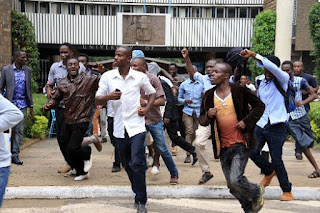
We weren't having it. The male comrades poured out from Hall 11 and led a campus-wide strike while we cheered them on as they went down towards Uhuru Highway with twigs and chants- "nyama nyama nyama-- nyama! Ya meatballs-- nyama!"

Before you know it, boom was gone too- that allowance that equalized all students, making the DF and the Ozone all equal opportunity boom-box owners; water was heavily rationed at the halls of residence which caused serious unsanitary conditions; janitors who cleaned our rooms were laid off; new students had lots of upfront expenses...

Things have never been right since. Ours was the end of the age of paradise. We had it good, better than those who were scurried off straight from high school to colleges in London, NY and Paris, courtesy of able relatives. They never had meatball heaven and boom and Visions and late night chips at Exotica. They had loneliness and broke-assness and cruel winters. They missed the meatballs.

The Revolution:

The road to rotten institutions starts when they take away your meatball. I'm sorry, Kenyan doctors, that your meatball was snatched off of your plate so long ago, and you've had to scrape the bottom of sufurias to survive, and strike after strike you got played, and you've let go the crumbling pillars because your arms are too weak to hold up the roof, arms which they have now shackled in handcuffs, and the whole ugly mess has collapsed on patients...

There's a beautiful Kenya that we love to hold up as a poster of success whenever we're faced with our ugly side. The glitter of the cities and malls, the new infrastructure, booming businesses, middle-class estates, sunsets on peaceful countrysides... This is what we want the world to see and story about us. I want that too, because there are hard-working descent successful Kenyans living their lives just fine, and I abhor the pitiful singular stories that American TVs tell about my people. But that successful and happy Kenyan bled out and died waiting on a doctor at the maternity ward.


Things have been falling apart a long time. Kenyans had their Trump moment when they voted in the duo of ICC suspects. Whatever your politics, this was a deplorable moment. Kenyans still genuinely gave them a chance. The duo has had 4 years to prove skeptics wrong. But the President has lacked the balls to do a lot of things he had the power to do to set the country right. Now thugs and drug kingpins and greedy politicians have taken away the meatballs and stuffed themselves and vomited on our plates.

I'll say what I said soon after the last elections- that only a revolution will fix that country. It's coming. Let's hope an MLK arises so it won't be bloody.

Sere

Wednesday, November 23, 2016

Return of the Few

Remember that evil has never made its way into mainstream life as evil. Its masters work very hard in ensuring it comes clothed with the innocence of lambs. They'll call themselves nationalists, not supremacists; alt-right, not extremists; movement, not terrorists.

Too many good people would rather believe that the shocking darkness that humans have wrought upon each other- holocaust, slavery, genocides... will never happen again. Forget that the daily shredding of flesh is a reality in some parts of the world where bombs and bullets are the norm. But that's too far removed from the ordinary American reality.

Yet what is slowly becoming the norm in this exclusive American world is little "innocent" incidents of the same chilling darkness we assume can never happen again: a black student put in a noose, swastikas and hate-filled insults splashed across schools and churches, whites-only signs cropping up... Some people swat it off and think it all too inconsequential.

Often, I too hide behind the false comfort that American institutions are too strong and balanced to allow a few people to plunge the country into that unimaginable place. False because those few people are now celebrating their mainstreaming, with presidential support, and those same balanced institutions can now easily be run by the forces of our greatest terror.

The only thing that will make this "the few" not go mainstream and become a darkness too great to bear is if you and I care enough to call it what it is and shut it down with all the weapons at our disposal when we see or experience it. Roland Martin used his weapon, you can too.


Saturday, October 08, 2016

Beliefs and Bullshit: The Moral Terror in Ezekiel Mutua’s Head

Mr. Ezekiel Mutua, MBS, is a troubled man. He doesn’t know it yet, but he needs your prayers. Let me explain. You see, as the CEO of the Kenya Film and Classification Board, he’s been brandishing sabre and sword in a holy crusade against immoral storytellers. I’m completely awe-struck by his unparalleled zeal to fight what he calls moral terrorism. Imagine that. This man should be working for GSU Recce Squad’s Moral Intelligence Division.

But I can’t just wish him off to the terror-inducing people at Recce Squad where he really belongs. As a Kenyan storyteller looking to contribute content on stage and screen, I’d better get to know Mr. Mutua, because he’s got a big whip and I don't want him lashing the skin off my back for the content of my stories.

It so happens that in my next play there’s a lady in a red mini skirt with the hem just below the Bermuda Triangle, mounds of thigh extending southward into smooth shin-and-ankle stuck in a pair of six-inch heels. There are two men who make lip contact ever so gently, just for a second. There’s also a bridal party scene with a Kiganjo policeman stripper who pops out of a big bible, mundu-khu-mundu muscles rippling as he gyrates out of some massive pages, all while Alikiba blares through the speakers- “haya chekecha chekecha haya chekecha cheketua...” And Mr. Mutua MBS, loves the word “debauchery.”


I discovered we have something in common. We both like to air our thoughts out loud through a keyboard. His Facebook page is an open window to his vain soul. He’s very present, engaging and unafraid of his own beliefs. Only he is blind to the bullshitness of his morality crusade.

In his mind, he’s on an apocalyptic mission to save Kenya, because God forbid Kenya’s storytellers should succeed in putting Kenya in a big envelope and mailing it off to the big bad devil. He believes this. His other sworn enemies are atheists and homosexuals. But we’ll get there in a minute.

Mr. Mutua says he’s on a mission to protect Kenya’s children against the debauchery of family-time programming. I don’t know what’s been showing on Kenyan TVs lately, but there’s a gadget called a remote control. Change the freakin’ channel! And if you have only one debauched channel on your TV, do some creative parenting. It’s not KFCB’s responsibility to police parenting between 5 and 10PM when the moral code is supposedly in force. Don’t spoil other perfectly balanced families’ enjoyment of the sizzling intrigues of life and love, coming to you con amor, from Mexico.


It’s perfectly alright for Mr. Mutua if he’s reading his bible at this time. The problem is that he can’t sleep because images of moral decadence torture his soul. Seductive females and homosexual hotness and mournful orgies at bridal parties float through his mind. I’m not kidding. It’s all there on his Facebook page, in his own words. And he thinks the rest of the country is haunted by the images in his mind. There's some deep private conflict burning within him, a personal moral battle that he has decided to transform into a national pursuit. Now you see why he needs your prayers.

He swears on the Constitution so authoritatively you’d think he’s right. He’s not. Kenya is a democracy, not a theocracy. Mr. Mutua seems to have these two all mixed up in the same bowl. There’s a whole bill of rights that guarantees every Kenyan a right to equality and freedom from discrimination; freedom of conscience, religion, belief and opinion. To believe that one must believe in God in order to possess a moral compass is a load of bullshit. There are many atheists with higher moral fortitude than some professed God-fearing people whose morals make a blue-flied pit latrine smell like Suzzana pomade.

Mr. Mutua bears the responsibility to encourage only quality of content. Just quality. The bullshit about doing God’s work as moral police is his personal vendetta against the perverts of his mind.


Sunday, September 25, 2016

Beliefs and Bullshit: Getting to Third-Level Heaven

Visit to the Mormon Temple, Washington, DC
My neighbors two blocks across kept on wanting me to go visit their temple with them. My resolve to dodge their relentless invitations was finally eroded and I caved in. Off to the Mormon temple we went. It was all my fault. I caused it during casual conversation when I said, having just discovered they were Mormons, “Oh, I always wondered what that magnificent structure looks like up close.” I say to myself, Self, leave these passing curiosities alone. Now look, you have Mormonization on your schedule.

We arrive. I get a tour of the model of the temple, a miniature structure that sits inside the lobby of the office building across from the real thing. I say, I’m getting a raw deal here, can I get a tour of the real thing? I’m told, no, but you can go in there once you’ve become one of us. Do you have any questions? I say yes, plenty. I can’t help myself.

For almost two hours, my neighbors – quite a sweet elderly couple really, and two missionaries, take me to a room, show me a mediocre movie on family values, and get the proselytization process going. It was pure fun. All that Mormon testimony and all my counter-punches against absurd beliefs. They took it in good stride.

I say, all religions are irrational, except they have rational goals such as the earthly accumulation of power and wealth through membership recruitment, which Christians call “winning souls.” Your church, I say, which you of course believe is the real deal, is no different. All that you believe is in the realm of faith, and I cannot argue with it using logic. So I’ll just entertain it like I entertain the rest of other folk’s absurdities. As long as it does not cause harm to another human being or living thing, I don’t care what you believe.

At the core of Mormonism is the beauty of shared values that makes us all better people. I say, those values are universal and one doesn’t need a conversion to a Mormon Jesus, Catholic Jesus, Evangelical Jesus, Mohammed, Buddha, Lord Krishna… to find them. Then from out of the blues Miss Missionary tells me that God is a flesh and blood male living among us. Jesus too! That he goes shopping and passes gas. Ok, they didn’t exactly say that last part, but by all indications, the Mormon God farts. I say, but does it have to be a man? It would have been so functional if it was a woman. With massive tits towering above her head and curving out like the horns of a Matador’s bull, aimed straight at evil-doors so there’s no bullshitting with wars and all that hurtful stuff humans do to each other. People would just see the big tit horns coming from a distance and sound a warning to each other- hey, guys, She-God is coming! Quickly, throw Trump in a cave! You Boko-stupid-scumbags, return those Chibok girls! Someone go say sorry to Trayvon mama, and Freddie mama, and all black men mamas! Can y'all bastards stop bombing Aleppo and fix it for cri’sake! God Mama coming! But I didn’t say all that out loud like that.

I didn’t want my neighbors feeling too bad about their hard work bearing no fruit, being such nice folk and all. So I ask them, what are the benefits of signing up to these beliefs? I’m told, after this physical life, I get to go to the sun heaven. There are three levels, you see: star, moon and sun heavens. I say, wait a minute, there’s no hell for the unbeliever? No hell, they assure me. Said straight up- we Mormons don’t do that hell bullshit. O, I love your after-life much better than those fire and brimstone guys, I say. Such terrorism. So if I don’t get Mormonized, my after-life punishment will be getting thrown to the lowest level heaven where I get to float around among the stars. How cool is that. Mormons rule!

I’m given a card, in case I still want to join the no-hell church. I say, I’m not worried about my after-life. When I’m gone, I think I’ll be sap in the trees. I’d love that. Or the wind in the forest. Or one of the monarch butterflies. I don’t think I’ll need a mansion in heaven- all that maintenance and property tax, no. I also don’t care too much for streets of gold, because then I’ll have to wear shoes with suction pumps so I don’t slide, and dark glasses to keep off the glare. And that choir of angels singing endlessly, no no. I’d like some quiet in my after-life, some Stevie Wonder, Richard Bona and Miriam Makeba. Maroon Commandos too. And that Grammy award-winning Mormon Tabernacle Choir. Most of all, my grandma’s soft singing, “Andu iruwa jabuka, hata na andu jiswagha…” 

Sere

Sunday, February 14, 2016

A Tale of Horror, Heart and Humanity

Whose body is this?

Leaving Nairobi on Thika highway
"They are going to kill us in Thika. Thika is far. I will need to be identified..." That's exactly what was going through my mind as the hijacked matatu sped down Thika highway at breakneck speed. I was working out logistics of my final moments, what would be needed post-disappearance.

I wanted to ask the skinny guy with the gun to my head to return just one form of identification - my passport or credit card - and place it in my jeans pocket. That way, after they had dumped our bodies, someone could identify mine and allow my husband some closure- whatever that means. Right this moment, I really needed assurance that I would be identified.

But I stayed silent. They had set the rules: one word out of anyone's mouth and you get shot right there and then. I knew they meant it. They were cold-blooded killers. I wasn't about to give him reason to pull the trigger.

The inefficiency of traffic police allowed the hijackers to drive as fast as they wished without fear. Memories of a time when matatu hijackings often ended with all passengers killed and dumped in maize plantations flashed across my mind. This happened enough times during the Moi era. You think things are bad now? You must not have been born during the one-party police-state dictatorship era of dungeons and disappearings. We survived that.

"Unaficha nini, eh?? (What are you hiding?)" Skinny-guy gunman next to me barked as I reached into my pockets to empty them, as per his own instructions. "I find you with anything and I'll blow your brains out right now." He so desperately wanted to pull that trigger. In a flash, his colleague behind him, equally drunk with the excitement of the moment, suddenly struck out and landed a steel-knuckled fist right on my cheekbone. The force was so strong I thought I was about to black out.

Some weeks later, I recall narrating to my young nephews how this guy hit me so hard, "twaaarf!" I had to snatch back my head from where it landed after flying off my neck. They laughed so hard. Times when tragedy takes on the mask of comedy, and laughter allows you a sliver of closure. I really didn't think I had any closure issues to deal with. Or did I? This hitting part of the story always got my adult listeners asking, why, why did he hit you?? I could write a whole book on the "why".

"Habari Mzee"

"Leo naskia kuua, haki tena!" Steel-knuckles behind me said. What on earth were these guys on? His friends, a gang of four all together, told him to quit his bad habit, that lately he'd been killing ovyo-ovyo, and that last time he killed without orders. Well, that established it. These guys were at work, and they were trying to establish best-practice.

"Give me that ring!" Skinny-guy yelped, trying to yank my wedding ring off my finger. It annoyed him that it wasn't coming off easy, as if it was my fault. The ring had lived on that finger going on nine years; it had a right to protest dislocation. The man pointed his gun to my finger, He was about to blow it off and free the ring. I closed my eyes and waited for the blast. I pulled my finger while he made a final yank. Pop, the ring came off. Small mercy. I would be identified with all my fingers intact. One day, I'll tell you about that ring.

The getaway driver, a mature man with enough gray hair to qualify him an African elder on a good day, steadily pushed the gas peddle to its limits, zooming past traffic while the night's drizzle danced its nightmarish patterns on the windshield. Were I to meet this thug driver the next day at the bank while he deposited stolen money, I would not remember his face, and I would greet him respectfully, "habari mzee" on account of his elderly look.

"Miguu juu! Yote, yote!" Skinny-guy screamed at me. He lifted my legs and forced my feet onto the little platform that projects behind the driver's seat. He wanted to make sure I was not hiding anything under the seats. Kenyan matatus have a quarter of the leg-room you find when you're flying economy class. They are made for nine passengers; they fit sixteen. My knees came up to my face so that my whole body formed a poorly twisted pretzel, my butt barely resting on the seat. The thugs had thrown the real driver one row back so that he now sat squeezed up next to me. With all the discomfort, my mind was alert to the moment, calm, just concerned about the lack of identification on my person.

My mind raced back to the moment I boarded that number 23 matatu at Odeon. I'd been in the country all of 2 months, having traveled to produce my latest play at the Kenya National Theatre. On this particular day, I had come from a rehearsal session at Kenyatta University, preparing my cast for opening night in about a week's time. My husband and I had taken some insane risks to get this production on stage. It was terribly lonely doing it without him around, and phenomenally unsettling to walk the tight unsecured rope of dream-weaving. Little did I know the rope was about to get even tighter and snap right beneath my feet.

You're far, far away

The matatu from KU had gotten to town late on account of the rains. I got off way-way downtown as the traffic was not moving, and started inching my way towards the city center. It was dark and raining harder. I got completely lost, ended up in a place in the outskirts of the city that I could not believe existed. Dingy street after dingy street, people e-v-e-r-y-w-h-e-r-e, thousands of them, in the pouring rain, walking about, laying on the pavement, darting eyes following you, a man jumped in my path to scare me and laughed his head off. I felt as if I'd fallen off the edge of Nairobi into a purgatory of grotesque human forgottens.

I walk-raced briskly, making sure I was a constant moving object. I clutched my back-pack tightly. It had my entire world. I took off my glasses as the rain on the lenses kept blinding me. It seemed to me I was walking endlessly, moving deeper into a Dante's Inferno. I darted into a store and asked for directions to Odeon.

"You're far, far away!" With the directions I got, I got back on to the dense forest of humanity and relentless rain, through the darkness, shady aisles, breathing in air thick with the night's dreadful awakenings. There was an entire city, unknown to the world, that arose in the night. Did you know that! You did not want to be found in it if you did not belong to it. It almost felt like eternity before I saw the familiar sight of Coast Bus station which guided me towards Odeon where I quickly jumped on to the first number 23 Nissan matatu I saw. I was on my way home! A man sat next to me. I relaxed, took out my phone, and sent a text to my husband.

me: honey, you best get down on your knees and thank your God your wife is safe in a matatu heading home

him: [after a while] ok i just did. what happened

me: had a horrible experience... it's about 9:30 right now

As the matatu left town and headed on towards Westlands, I texted on, narrating my walk through Dante's Inferno. Then I suddenly had this nagging feeling that this could be my last conversation with my husband. This is the truth. So I started doing goodbye-speak, telling him what he meant to me, that I loved him, and never you forget that...

him: hon, is everything alright?

me: yes, just a little shaken.

My eyes were glued to my phone as we started texting between two worlds. It was still daylight at home in Baltimore, and at home in Kenya, the last of late-night hard-working Kenyans raced home to rest. We texted on about the mundane- what came in the mail, the fall leaves that needed raking, his discovery of a new omelet recipe that he couldn't wait to make me, the wonderful rehearsal session in KU...

Squinting through chaos

Then suddenly, there was a whoosh. It wasn't a sound. It was the feeling of a dark force descending in a split second. Like being enveloped in a vacuum where not a ray of light or life existed. It lasted but a second, before awareness came in. This must be what evil looked like. So often in life, we touch that line between the physical world and the metaphysical other, but the experience passes so quickly that we do not capture it, we do not let it linger, we move on quickly back to the world of dense matter that is easier to grasp and explain. Back to the moment of sudden chaos.

I had no idea what just happened except that the matatu had pulled up and the man next to me was holding a gun to my head, three voices were commanding that nobody screams and commenced to harvesting all valuables. My phone was snatched mid-text. My bag and all the studio software with complete soundtracks, computer, camera with fresh video clips and photography, voice recorder, scripts, loads of documents I had painstakingly saved up over a period of two years, and all my back-up memory chips - gone.

That morning, I had taken a world of valuables I never carry with me. I had anticipated I would need to be well equipped for my KU session. I had also taken my credit cards and passport so I could facilitate production payments. The thug holding my bag could not believe his luck as he went through his loot. My eye-glasses were in there too. I squinted through the unfolding chaos as it dawned on me that I was in big trouble. I had a production opening in a week, and everything I needed to get it on stage was gone.

I was in pain, my head throbbing from the blow, my limbs numb from bad posture as we cruised through traffic. The whole vehicle with its nine passengers, all in different stages of shock and muffled terror, was quiet as death while the thugs discussed raping the women. They made jokes, asking the hijacked driver lewd questions about women. He trembled, clutching on to his unbundled mukorino turban that had been yanked off while they threw him off the driver's seat. Whatever religious identity that turban held, I suppose it felt both defiled and false, as if a non-existent deity had been unmasked. Times when God became a spectator.

The driver suddenly made an exit from Thika highway and got onto an unlit road that quickly became rugged. We bumped in and out of potholes, and I surrendered to the twisted discomfort of my body as a new normal.

Ruaraka Member of Parliament

"Shame on the MP for this area! He's the one we should kill!" Steel-knuckles barked. Now that was funny. I almost laughed out loud. The killers wanted good roads to ease the hardships of their job.

"Let's not follow the usual route. We get to base from the road further down." Their leader said. Their eyes could somehow do a quick scan in total darkness and decide what route was safe. They were creatures of the night.

As the vehicle made its way into the dingy backroads of an unknown neighborhood, I begun to see shacks similar to those in a slum. Cardboard shelters strewn here and there, and the population got a little thicker. I could see shadows, the wretched of society going about their daily business well into the night.

The matatu came to a stop, and the hijacker-driver ordered his men out. There would be no raping tonight, and no killing, at least not in this matatu. It had been a fruitful raid, all passengers had complied and kept the peace, no need to create inconveniences. They alighted, so that it seemed as if they were just passengers getting off a matatu. They blended in with the moving night figures of the hoi-polloi, no one knowing they were armed hijackers. From the open door, I saw a woman walking by with a big basket on her head, perhaps a hawker heading to her cardboard shack to feed her children.

The real driver got back to his seat and together we started finding our way out. No one knew where we were; we just wanted to get out of this hell. But the driver insisted he has to make a police report, and I agreed with him. After driving a distance trying to find our way out, we were guided to Ruaraka Police Station.

Making that police report turned out to be a lengthy ordeal and gave me a lot of thinking time. I had became aware of being surrounded by a different kind of existence, a world of struggle, squalor and social marginalization not too far away. I thought, if the slums are where the thugs come from, they still did not represent the oppressed proletariat; their occupation was not a protest against the immoral excesses of a capitalistic society.

They were not the disenfranchised youth doing a Robin Hood for their hungry families. They were not the struggling jobless citizens simply doing the only thing they could to survive. They were men who had made the conscience choice to become robbers, killers, cold-blooded terrorists of the night. No amount of poverty, bad politics or misfortune could stand as an excuse for one's inhumanity against another.

I have lived long enough to observe that there is a lot of noble struggle and triumph that rises daily from the lowest ranks of society, from those who refuse to wallow in victimhood and demand dignity through hard work, from the left-out who empower themselves through education and restless protest that awakens the spirit. The slums are also a boiling pot of unsung inventions, rebirths and quiet victories.

The others

My linear thought-track was momentarily derailed by the sound of sobs. I got to comforting a lady, one of the passengers, who couldn't stop crying. She was a student at University of Nairobi, lived alone. I started stitching together parchments of stories from the other passengers.

A young man, a student in Architecture, told me he lost all his homework and had no idea what he would tell his professor. Another had lost his medicine that he picked up from the pharmacy, and how was he going to afford it. A quiet fellow who escaped with his phone shared it with everyone who needed to make a call, the fading battery clinging on bravely until everyone had been served.

I asked the conductor what his story was, hoping he wasn't a part of it all. He looked lost, shaken, said he knew in his gut they shouldn't have done this last trip, now look. The lady who sat by the window next to me told me her day had started off with bad luck, woi-woi, and she broke down and wailed bitterly. There, there, I said, you came off with your life is all that matters. With each passenger, you could see a thin coating of anger begin to build up right above the swollen hollow of violent assault. With time, it could turn to bitterness or apathy or righteous outrage.

"Sir, what is your name?" I asked the police officer.

"Tuta," he replied. Inspector Tuta of Ruaraka Police Station was nonchalant. This was daily routine. He said the hijackings were common, no need to arrest them because they're always released anyway. He was like a waiter, wiping off the table after a meal. Sigh... the gangrened arm of the law. From the recesses of the grotesque, I did a double-take of Inspector Tuta's arm, just the off chance it could actually have gangrene. Insecurity was an epidemic Kenyans had mostly chosen to be silent about. May be if we called it Insecuritephalus-Kenyatosis...

It wasn't until 1 AM that we were leaving the police station.

Home

We got back in the matatu, and the driver dropped us off at our various stops. When I got home, I narrated my ordeal to my sister and my brother-in-law who were waiting on me, puzzled about my whereabouts. I asked for a phone to talk to my husband. It was evening in Baltimore.

"Hi love," I said

"Hi. You went to sleep?"

"No. I almost got killed..."

A few weeks later when he joined me in Kenya, he said to me, "That night, when you told me what happened to you, I lost my faith."

"Why?" I asked

"You asked me to get down on my knees and thank God that you were safely in a matatu heading home. I did. I got down on my knees and said thank you, God, for keeping my wife safe. And soon after, someone had a gun to your head. Tell me, what kind of God does that?"

"I don't know, honey." I too couldn't defend the God that we were putting on trial right then.

My husband got the sordid details, all else that I have left unsaid to the rest of the world. He's a man with an emotional IQ that goes far above the average guy and can handle depths of emotional detail. His presence was the soft rain upon my bruised mind.

"It's ok, baby. I'll find them."

I remembered that the next day after the ordeal, my sister had organized funds, chauffeured transport and medicine. And later, she had brought on my biggest audience. Love surrounded me. 


feb/14/2016

sere

Sunday, January 17, 2016

What If


I've always marveled at a marathoner's staying power. Have you ever watched those Olympics marathoners? I watch them, especially the Kenyans and Ethiopians, how they start off on an easy trot, as if on a romantic jog in the park, their feet going, step-lift-jump, step-lift-jump, carrying a light body-frame round and round the tracks, overlapping those who cannot keep up, without ever changing rhythm, not a drop of sweat on their brow it seems. And just before they get to the finish line, they lurch forward with a sudden surge of power on their heels. Just like that, they win, and walk off the tracks as if they just came from visiting the next-door neighbor.

It's amazing, really is. An astonishing work of art. Seems so easy, until you take a pause and think about what got the marathoner to winning the race. Years of practice, defeat, frustration, getting up from a fall, and running again and again. It all started with the question, what if? A young lady sitting by the fireside with a bowl of porridge, tired of the humdrum in her life, knowing there must be more to existence, and while looking intensely at the burning embers, she feels a certain itch in her feet and goes, what if I ran? That simple what-if becomes the Olympic triumph of a villager.

You've probably answered to a certain itch yourself. What if... A dream you got to work on, daring to tell the world about it and got an audience to watch you as you built it. Then things didn't go too right. You ran out of bricks, got bruised building it, started slinking back into the lonely darkness of your struggles to face the frustrations, fear, defeat, rejection, and you decided to readjust the size of your dream, cut it in half so you can survive. Those who saw it thought it excellent, gave you applause, awarded you, but it was a far cry from what your mind had conceived, a mere drop of water where you had promised a full calabash. You still need to get back on track and finish it. It's never a one-shot deal.

At JKIA. After 4 months of a what-if, getting back to rebuilding
Life on earth is very short. In the blink of an eye, we're come and gone. We depart from this world in mid-step, mid-sentence, half-way through our marathons. No one ever says, “I have finished life, I'm ready to depart now.” We usually just keep on moving from one task to the other, hoping to live long enough to experience something spectacular. Departure is a certainty, and life as we know it is totally meaningless unless we imbue it with meaning. Let your slice of life on earth not run out before you give your what-if a shot. It's spectacular really, just daring to make a what-if become what-is.

Einstein asked, what if I moved at the speed of light and saw the unseen? Mother Teresa asked, what if I touched the untouchables and defied a religion? Gandhi asked, what if I became non-violent against an empire's army? Maathai asked, what if I spoke for the trees and stood up to brutish men? Jesus asked, what if I became the son of God and dined with outcasts? You can expand the list. They, ordinary people with feet of clay just like you and me, changed the world spectacularly. They had a marathoner's staying power and did not care when their lives would end.

What if I told a story true and gathered a nation to listen to it?

Sere

Wednesday, January 13, 2016

About Nerea's Baby

Flashback, 2-3 months ago. I'm in a matatu in Nairobi, and a beautiful song is blaring out through the speakers. The lyrics are quite a story. Guy is begging his ex-girlfriend, Neria, I think is her name- not to abort his child, because when God makes a child, he brings its plate with it. I burst out laughing, passengers think I'm schizo for sure. You know that's hogwash. No, love is not an issue; there's plenty of that. But you find the plate yourself to feed that child- work, beg, borrow, steal or hope “the village” raises it. Then if you're a person of faith, you thank God for doing it.

Has any country ever prospered without addressing its population issues? I think not. China did with its brutal one-child policy; European countries did, to the extent that some feel they now have an underpopulation problem; the US did, with its historical controversies still raging, re- Margaret Sanger and Planned Parenthood. Good or bad, they connected a child and its plate of food to policy.

The only mention of Africa in Obama's SOTU address was with regard to America feeding Africans, fighting AIDS, and eliminating Malaria. Stay with me; I'll post on good stories from Africa later- a thousand pages of it. Back to population and the economy. Kenyans like to say we don't have an overpopulation issue, because, look at how much land is still unoccupied. Overpopulation is not about square-foot per person, more like plate per person.

So imaginary Neria's baby will add to Kenya's population explosion, which no one is addressing as a matter of policy. I don't want her to abort it either, but that's a long debate for another day. Tackling population explosion will always be a sensitive issue, deeply personal, none-of-your-business stuff. But there's no plate of food that automatically drops from heaven with the birth of a child. You want to talk about the number of abandoned children in Kenya alone? Visit any odd police station in Nairobi and take a look at that massive poster displaying countless faces of abandoned children, with the caption- have you seen their parents? Abandoned, not stolen. Their plate of food may well be coming from America. Darn it, I await the day a sitting US President will mention Africa, prosperity, trade partner, all in the same sentence. Not food-plates and AIDS and Malaria.

I found that song! Nerea, by Sauti Sol. Enjoy it.


About Nerea's Baby: Part II

So it was brought to my attention that those lyrics to that beautiful song, Nerea, say that if God brings a child, he brings it in his own time. I checked them out. The Swahili lyrics provide both aural and linguistic ambiguity with the words “analeta saa ni yake”, easily heard as “analeta sahani yake”, because that's what makes sense to the mind. It's rather meaningless from standard Swahili point of view. Perhaps it's an attempt at poetic arrangement, or it's Sheng. Art being art, it makes room for both the composer's intended meaning and the consumer's interpretation or thematic deconstruction. Music is always first subject to aural interpretation, mis- or re-interpretation.

So, I'm thinking about this imaginary Nerea's unborn child again, and why its father wants it to escape an abortion. His reasoning, it could become the next Lupita, the next Obama... a long list of greats. Ok fine. Hey look,  I'm not for ending a life in gestation either, with exceptions. But it could become a serial killer too, or an abandoned baby.

That image of a massive poster with faces of abandoned children at Ruaraka Police Station, it's hard to get over it. I had enough time to stand there and peer into the faces of all those children ranging from 3 months to fifteen years. They represented only but a few of thousands of mothers across Kenya who abandon unwanted babies. Kenya went through an intense abortion debate during its Constitutional reform period. This debate should now extend to the formulation of policy and legislation on unwanted children- which includes the exploding number of street children.

So many times (I find myself addressing Kenyans here), we surrender our responsibility to think and when we make severe mistakes like having thousands of Nerea's babies ending up on an abandoned children's poster, we get all spiritual- God will provide a mother, a loving family, today's food, school fees, etc. Yeah, ask that 15 year-old boy still waiting on God's timing, having been abandoned at birth. Kenya's God must have one heck of a cynical sense of humor if we keep making him responsible for the birth, abandonment and street-raising of unwanted children.

So what's the solution? I said before, it's not easy addressing population issues. Effective national solutions will get emotional, ugly, even brutal. Every time I visit Kenya, usually after a year or two, I'm overwhelmed by the additional swarm of people in the cities and in rural Kenya. You have to be away to notice it. If we fail to do anything, nature acts. I remember in high school we learnt about the Malthusian theory in a Geography class. When a population overwhelms available resources, disasters (man-made or natural) will create an extermination factor and resolve the situation.

Valid theory or not, we have to do right by a generation before we conceive it, especially when we have the power of wiser choices, and the better mind to instruct or legislate. Aren't we tired of seeing the littering of cities and townships with children we treat like garbage. It's not God's timing that conceives them; it's ours.

Sere

Sunday, September 20, 2015

The Savoury Smells of a Sojourner's Soul

I walk round the bend from the Kenya National Theatre and down Kijabe street, looking for the food kiosks I once knew that stood some place near Text Book Center, or so my frayed memory tells me. There, we would consume chapati-mayai and tea. They think up the most innovative combinations of dishes on the streets, the kind you'll never find at Java. The thing about street foods is the smells- O lord, kill me dead. I'm disappointed the food kiosks are gone.

I keep on walking further down, all the way towards the Globe roundabout, and suddenly, those intoxicating smells come rushing at me- where are you... where are you... there! I emerge from the dip of the road into a stretch of food kiosks forming a hypotenuse leading up the hill towards Moi Avenue, hidden from view, but announcing their presence from angles where the eyes see only the tar-baked hustles of a growing city. I follow the smells, and there, standing inside one of the food kiosks is a lady wiping a plate with a dish cloth.

She's bespeckled, clumps of grey hair beneath a flowery headscarf dignifying her searching look as she gazes out towards the approaching Nairobian. Something about her- I think it’s the way she stands there, like a feminine billboard stretching upward, twenty-by-ten. I approach.

“I’d like some food”, I say in Kiswahili.
“She doesn’t understand Kiswahili”, her assistant tells me.
“Ah, O well, I’d like some food”, I repeat in English, “For eight very important people”

She’s puzzled. I proceed to tell her I have an important meeting, with people coming all the way from Mombasa, and I want good food made for them and taken to the Kenya National Theatre.

Now she’s really puzzled. Can’t I see she runs a simple street operation with a table for four, plastic water jars, maandazis in a plastic bag behind a counter that's pretending it belongs in a five-star setup. For a moment, that counter seemed to dare me to question its social status, its very identity; I leave it alone. Then something must have happened in the lady's mind, a shift that moved a cog of destiny a notch up, and she snapped to an invitation of the gods that neither I nor she quite grasped.

“Yes, I can do that!” She brightened and her spirit saluted the winds of purpose. Purpose comes visiting, unannounced, a parasite in one’s body, delivering its fortunes to another. I knew she was a sojourner from several borders westward. Her name suggested Rwanda, and I was right. I did not ask anymore. I knew her story before she told it. Not an arrogant claim to clairvoyance, but a discerning that said to me; don’t demand the full tale yet, just sit well in the knowledge that therein lies a tale with both a gripping familiarity, the journey of the stranger seeking fortune against impossible odds, and the unknown paths that could shock and inspire, enrage and transform.

We shook hands on a contract of passing strangers, no papers, the nib of faith signing on the dotted line of ignited dreams. Three days later, she and her son organized one of the most pleasant feasts which they delivered at the appointed venue. She was prepared, down to the savory inventiveness of the street food cuisiniere. Sanitary, classy, inviting in its simplicity. She took the menu I gave her and served it with novelty, providing us with far more than we had bargained for.

In those hallucinogenic smells that waft up one’s nose lies stories of the human sojourner as high as the city billboards, and as deep as the unscreamed terrors and the unlaughed joys spewing out from the eyes of strangers making a home in faraway lands. I have found these smells in the streets of Dar es Salaam, Addis Ababa, New York, Washington DC, and in my home cities, Baltimore and Nairobi. The arresting smells of sojourners serving out their souls. 

Sunday, November 09, 2014

The Thing About Our Brokenness

I never got their names. It's enough that they inspired this blog.
This past weekend, I sat opposite three people who were waiting to be picked up after a conference on disability and rehabilitation. They were all blind, some with a double handicap. The small guy in a wheelchair – yeah, that one with a blind cane towering above him – had just won a major award at the closing ceremony. Everyone passing by was congratulating him. I sat across the table from him and sunk into my observer-mode comfort zone. I went click-click with my phone camera, missing all the moments when they flooded the space with laughter.

This winner-guy’s joie-de-vivre was a thing of an alien wonder. The wheelchair swallowed his tiny frame, his lifeless legs dissolved into the folds of his pants, his eyes a decorative reminder of what light once flooded therein. But as he spoke, his personality towered above all that brokenness. His storytelling voice boomed. His laughter leaped in gales that rushed to the shore and retreated with the debris of my hidden shards.

I watched as he raised his right hand every so often in a confident preparedness for a congratulatory handshake from well-wishers. Some, passing by quickly, didn’t notice the outstretched hand. They were mostly conference staff clearing up the venue, their sighted eyes and moving limbs carrying them on autopilot towards a forgettable destination. Winner-guy took no offense as he withdrew his unshaken hand time and again. His stage presence rose undiminished.

As I listened, I realized that he rose not only because it was his moment, it was who he was. Somewhere in the stretch of his young life, he had mastered the art of conquering brokenness. Now he was cracking a joke, about the phone call he had just made to a friend:

“Yeah, so I bragged about getting the big award and he asks me, for real? I say, yeah, for real! He said, ya’ right! Did anyone see you get the award? I said, no.” Without missing a beat, the three laughed out so loud I found myself laughing along.

“Have you always been on a wheelchair?” The lady asks Winner-guy.

“Pretty much. Since I was four months old. Then when I was 23 I had a brain swelling that led to my blindness. I used to drive, do everything normal.” I wondered what “normal” meant for someone who had been wheelchair-bound all his life.

“Oh, my. It must be difficult for you now,” said the lady.

“Well, I was taught never to indulge in self-pity. I use my disability as a reason to achieve.” He went on to tell of things he’s achieved, including an interest in pastoral work. This solicited an interesting response.

“Churches can make you feel very guilty sometimes,” said the lady. I perked up my ears harder and waited for the rest of her thoughts. “They tell you it’s God’s will that you’re blind, or that it’s the devil’s work. It all leaves you feeling guilty that you’re being punished for something.” It’s at this point that I struggled to fight back my tears.

Her words had penetrated a well-guarded and mostly forgotten fortress of anger within me, and I wanted to cry it out. I have a loved one who’s been blind 35 years. Across my mind flashed images of desperate supplication at the altar of miracle peddlers who told her that she’s not getting healed because she lacks enough faith; anointing oils poured on her head to chase demons of blindness she had apparently invited; whispers of being an inheritor of curses for bizarre sins committed by some unknown relative in lifetimes past; multiple hands of barking prayer wolves shaking her head violently through hours of tortured ritual, causing her to spend the night with a splitting headache.

I could sue them, I could sue them all, I could sue them all to blistering hell. They took her brokenness for a playground to test out their power, their beliefs, their unquestioned trade. This lady understood. But unlike me, she laughed about it. She stood triumphantly above the cracks where religion had caused her inner brokenness. I had sunk defeated through those cracks and therein hid my anger. The tears welled up at the plunge-pool of my eyes with a fermented burning. I released them with a blink. I was now free to laugh about it all.

The suit guy is a listener. He doesn’t say much. He listens with his whole body, his head tucked deep into his chest, moving to stand very close to whoever is talking. He has no concept of personal space. That’s an invention of sighted folk in civilizations that have decided that the energy field of another human being causes discomfort. Standing too close to a stranger is an infringement of an unspoken right, mostly perceived as foul and primitive. In the villages blind to individualism, the six inches of personal space is a non-existent concept. 

I find myself wanting my space too. Yet I wonder, have we diminished our humanity in the course of building walls to protect individual comforts? I watch Suit guy as he inches his whole self right up to the lady’s knees when she starts talking, just to stand and listen. I've seen this with a lot of blind people; this listening with your entire being. I’m filled with the warm wonder of rediscovered innocence. I know he’s not hard of hearing, because another lady, perhaps his wife, calls out softly from the doorway and he turns around, tap-tapping purposefully towards a known destination.

We live in a world where able-bodied people scratch at the scabies of their smallness for reasons to explain their purposelessness, their lack of accomplishment. Brokenness that can be overcome with choices and attitude adjustment is often qualified as “disease” that places one on the line for benefits and entitlements. There’s always someone or something else to blame, never a mea culpa. The art of petulant high-nosed victimhood is wearisome and detestable. I was getting an attitude re-adjustment myself just listening to these three.

But it’s when Winner-guy mentioned his wife, casually and endearingly, that I caught the stench of my own assumed superiority as a limbed and sighted being. How conceited of me to have been surprised that someone has loved him into spousehood, completely, publicly, without shame. Life’s most awesome experience, the experience of another’s unconditional embrace, is best savored when we do not hide our brokenness in shame or lay it out as a trap to catch another’s pity. Winner-guy seemed unpretentiously happy, content, alive. He was someone’s knight in shining armor.

sere


Tuesday, July 22, 2014

Flipping the Mask of Absurdity


Some 20 years ago, I was in the cast of Samuel Beckett's one-acts, directed by a visiting French company, Theatre du Shaman. The thing is, we struggled to see the humor the director insisted was in Beckett. We just couldn't see it.

How on earth could the doom-and-gloom of Beckett's absurd theatre be funny? We refused to laugh, we refused to learn, we refused to consider another experience. His drama was etched in the ink of existentialism, a world where human existence had all together forced the birth of a philosophy of meaningless.

As a society in communal Africa, no matter our hardships, we had not reached a point where the idea of life as a stretch of futility had built up into a shared philosophy of meaningless absurdity. We couldn't recognize it, therefore couldn't laugh at it. African societies have collectively gone through terrible soul-searing experiences, but I'd argue that the philosophy of "utu" (the one as the whole and the whole as the one), disallowed for the emergence of philosophies that were embedded in individualism. European individualism separated the one from the whole and allowed for the emergence of the absurdity of life as a philosophy.

Not surprisingly, the reviews in the Kenyan papers were about the "soulless" production showing at Alliance Francaise. The reviewer saw the characters and their situation as empty, devoid of human heart. I was playing one of Beckett's characters, and I felt like a plank of dark wood moving mechanically through eerie space. I failed to appreciate the European bloody backdrop of war and loss, bombs and cold slaughter, that informed Beckett's personal experience and his works.

The director failed to inform us of this background and how it shaped intensely alienated characters. We might perhaps have understood Beckett's struggle to laugh at it all, to scoff at a phantom god who had no effect on human choices and suffering, to boldly question dogma and follow our natural instinct as free thinkers.

It wasn't until over a decade later, having lived through the intense alienation of one misplaced, one waiting for Godot, that Beckett's world became real to me, and I laughed my tears into dry salty streams at the absurdities of life.


Meaninglessness had come home to me, and I realized, with a desolate shudder, that giving my life meaning was my responsibility. Questioning was my responsibility. Tearing down institutional thought that shackled our freedom to believe our experiences was my responsibility.

Why does Beckett come to mind now? I think the doom-and-gloom of a war-weary soul is once again fast becoming my daily companion.

If I'm not waking up to news of wars fought with irrational claims to divine privilege, from Zionist god-gave-me-this-land to Islamist 72-virgins-await-me-in-heaven; mindless jihadists blowing up innocent passengers and worshipers in Kenya; congressional brutishness baying for blood and war profiteering in someone else's country, then I'm constantly shocked by the absurd binge of materialism that leaves half the world decaying in destitution.

Our experiences have become more global, less particular. We now share the dank blanket of meaningless terror, thanks to its manufacturers.

I think it's in finally waking up to the humor in the absurd that we begin to find our way out of it. The realization of what we're capable of as human beings is both shocking and absurdly funny.

I'm ready to laugh.

Sere

Tuesday, March 04, 2014

The Seduction of Inadequacy

These words come from one, Lupita Nyong’o’s speech about beauty, given at the Essence Awards. The seduction of inadequacy. It refers to the alluring power of clinging on to pitiful definitions of ourselves; definitions that have taken root over generations of mental slavery, so powerfully and effectively injected into our African psyche that inadequacy has become a mental scourge we inherit and spread like a virus. Dr. Kenneth Clark’s Doll experiment of 1939 still rings true to date.


It’s December of 2013. I’m at Sarit Centre’s The Baby Shop in Nairobi, having already visited a number of children’s stores.

“I’m looking for a black doll,” I say to the attendant, still holding out hope that some Kenyan will surprise me.

“Sorry, we have none,” comes the matter-of-fact answer.

“Why? Why don’t you have black dolls?” I try to keep my cool. “I’ve been all over Nairobi and I can’t find a black doll anywhere. You know, 20 years ago I trekked all across this city looking for a black doll for a friend’s baby, and I found a hand-made one thrown at the back with broken merchandize. I dusted it up and bought it, felt as if I’d found gold. You must be the change we need.” I pause.

She says, “Sorry, no one will buy, that’s why we don’t stock them.”

“Do they buy these ones?” I point to the row of white dolls with blond hair.

“Yes.” She says, and continues defiantly, “But there’s nothing wrong with white dolls.” O, was she accusing me of racism?  

“No, there isn’t,” I agree. I'm too tired to argue with her that it’s not the choice of white dolls that is disturbing; it’s the lack of the alternative, which suggested a loathe of that which looks like us. I have also seen birthday cakes for little girls in Nairobi decked with white princesses in flowing blond hair. I suppose the image of a little black warrior princess with short hair, a Mekatilili of sorts, standing atop a birthday cake, would make the poor African girl weep her eyes out with horror. This horror has a deep-seated history

Enter Alek Wek, Djimon Hounsou, Lupita, and all the directors and producers who dared to bet on black. Wait- before they enter, please note, Africans come in all variety of shades, from the darkest cotton soil hues to the milkiest river-sand shades. The majority are “black”. White Africans whose ancestors settled in Africa from Europe do not suffer the same fate of inherited inadequacy as black Africans, but they are our fellow Africans all the same. See, Charlize Theron was the first African to win an Oscar but that does not mean she’s in the same position on the socio-racial totem pole as Lupita Nyong’o. It is the difficult task of our dark-hued African heroes to stand on that international stage upon which they have been thrust and dismantle the biased standards that place us at the bottom.

When an African comes to America, whether they end up as teachers, managers or Oscar winners, they are at first mercifully shielded by an ignorance of their positioning at the bottom of this socio-racial totem pole. They do not know that in the minds of those who have set up the hierarchy, they scrape the ground for scraps of dignity. My Kenyan friends bought a house in a Harford County neighborhood that had whites only. The neighborhood kids came by and wrote all manner of racist words on their shed. My friends treated it as a case of naughty kids and moved on. Privately, they were awakened to a new reality.

Naivety makes us Africans slow in applying our knowledge of history to the reality we find ourselves in. You hear a lot of Africans say, “I was not aware I was an African until I came to the US.” We just thought we were Kenyan, or Zambian, or Nigerian… “African” brings in the race identity, a concept Africans are oblivious to while in Africa. Africa is also a massive geographical entity with 53 countries. There's no singularity in the "African" identity; there are thousands of African cultures, religions, histories, all with distinct languages and norms. Africans identify themselves either by their countries or ethnicity, which is meaningless to Americans.

To the average American, "Africa" is a small village-country somewhere with a primitive tribe black as coal, running around shooting each other, dying of Aids, or going wooga-wooga with a bone in their nose. Surely, how can they have the same place of social belonging as whites? As we slowly learn our designated place as "Africans" while in America, we play the ignorant card and proceed to buying our way into the wrong nice neighborhoods, apply our way into companies that employ very few blacks, secure fellowships that seem exclusive, apply for PhDs because that’s what the village sent us off to get, and get an Oscar because why not.

In the privacy of our own knowing, we nurse the wounds we have suffered from countless collisions with attempts to put us in our place. Then we discover a certain beauty in this country; that the opportunities to rise and prove ourselves, no matter the obstacles, are right at our feet. It is the courage to conquer enslaving institutionalized standards of belonging and acceptance that frees us. When we choose not to be courageous, we fall back into the comforts of our inadequacy. We settle into the ugly cushions of mediocrity.

Only we can demand from ourselves an image of Africans that deserves to be celebrated. Yes, we deserve to occupy spaces of elegance, we deserve the spotlight that reveals our eloquence, we deserve the seats that elevate our smarts, and we deserve the second chances that prove our ability to rise from failure to heroism. But all this is hard work, a revolution of the beautiful.  We must give up the comfortable mediocrity that we now maintain at a heavy, heavy cost.

We maintain an image dross with politics of greed that has brought us civil strife; unstable economies that have brought us shocking squalor; gullibility that has made us fools for twisted religiosities and unquestioning servitude; apathy that has spawned a new philosophy of Utado? (what can you do?). The voices of change that seek our beauty where ugliness reigns are fought off by the ruling elite and ignored by the rising middle-class.  

There’s a lot of psychological damage to overcome in the fight against Africa’s real and imagined ugliness. We’ve been scarred since the early 20th Century when scientists falsely published as proven fact that the African brain is inherently inferior and ape-like, giving license to gross abuse of the African race and justification for colonization. And now the fear of our own beauty paralyses us. At the same time we're terrified that our Africanness falls far too short of anything admirable. Inward journeying into the discovery of the Imago Dei in us is an imperative.

Astonishing in itself, our beauty lies hidden beneath the planks of a thrust stage upon which stands a chorus of Africans too timid to raise their voices. There must be a trap door somewhere on this stage, a trap door that releases the fury of new courage so the audience may gasp in awe, a spectacle all at once overwhelming and consuming. 

Then the furious courage of a young lady rises from stage left, raising an eloquent voice, a schooled mind and a forbidden image that seems carved out of African Blackwood, until the gasp of an Oscar climax is heard around the world. Once again, Africans are startlingly, wholesomely beautiful.

Yet we must not pompously stagger under the weight of our own greatness when we become the instruments of its manifestation. We carry it with grace, like our mothers taught us, dancing to the seduction of our own adequacy.

Sere

Saturday, February 15, 2014

I Made a Promise

I made a promise this morning. I told my husband that I’ll meet him for a big special lunch today. It’s Valentine’s day. It’s a day off teaching for me, thanks to yesterday’s snow storm. He goes out to clear the snow, but my car is buried too deep. He has to leave for work. He's dejected. No big special lunch after all since I can't leave the house now. No wife to interrupt his daily routine. Lunch is very important to this man, especially one you’ve planted in his head in anticipation. A man leaving the house with a head hung low is painful to watch.

After he leaves, I call my mind together for a big think. I made a promise, and I intend to keep it. So me and my sore shoulder started digging out the car buried under two feet of snow, exhuming it after two hours. I call and tell him I'm on my way, we’re having a big lunch after all! Really??- He asks. Yeah, really- I say. I punch in the destination and head out in a hurry. Meanwhile, I can hear my husband thinking, “She found someone and paid him to shovel the snow.” That’s actually what I’d have done, but I had no time to find such services. I had a promise to keep.

After 15 minutes on the road, I notice – and here I go into a massive panic – that I'll be going through Harbor Tunnel in a few seconds. I swerve. I SWERVE. I S-W-E-R-V-E. I’m shouting so you understand the gravity of this situation here. I don't do tunnels, I don't do bridges. Something called gephyrophobia. Very bad. It doesn’t kill you dead, but you will die a thousand deaths while hyperventilating, spiraling into hell in an attack of extreme vertigo, tongue stuck on the roof of your mouth, bowels threatening to let loose as you slow down to a mile/hr and scream at the top of your lungs, all this before you miraculously come out alive at the other end of the tunnel or bridge.

A brief history. Gephyrophobia came to me suddenly on the Chesapeake Bay Bridge, without cause, after many years of stellar and fearless driving. I’m the one that used to speed across the Delaware Bridge like a Nascar driver. Life will always throw you a curveball. One day, I shall overcome, I promise. But today I have another promise to keep.

Before you think me a wimp, I’ll have you know that Mzee Kenyatta had a phobia for planes and elevators. On one flight, he’s said to have cursed all the way to JKA, made sure a fitting insult was delivered to the pilot, and that was his last flight ever. He lived many years after that, getting around in cars and taking only stairs. George Washington lived in constant fear of being buried before he's really dead, to the extent that he put it in his will to be left uninterred two days after he’s declared dead. Nixon had a phobia for hospitals, thought if he ever went in there he’d never come out alive. So there, I'm in the company of presidents when it comes to phobias.

I park and catch my breath after that close shave with the offending tunnel. Then I realize I'm trapped. When I swerved, I took a nowhere exit into some space under the I-95 overpass. I have to go back on the highway or else I become a story- “Once upon a time, a woman lived under an overpass...” Of course I won't go back on that highway. You don’t know my resolve. I’m not moving. So I sit and wait for God. I call my husband and explain the situation. He thinks it funny. It’s a relief one of us can laugh about it. I tell him I can’t make the big lunch after all since I don’t know what time God will show up.

While I sit through this perfect convergence of storms and phobias that have conspired to make me a fraudulent promisor, it strikes me that relationships of all kinds are contractual. They consist of promises made here on earth between two parties. In marriage, “made in heaven” is exactly what it sounds like; fairy tale. Neither of you have been to heaven to sign any contract. You signed up to an institution made right here on earth, governed by laws and parameters decided by imperfect humans. The seal of authority on your marriage certificate is a government seal, even if it's His Holiness Rev. Dr. Ogbuefi Adegbayo of the Holy Fire of Christ Church who married you.

It is here on earth that you work things out, change the laws that don’t work for you, until the institution provides you with the best structures that allow you to keep the promises you made to each other. Of course you can make all manner of wonderful promises without a man-made institution like marriage; they are still binding moral contracts upon which your integrity stands. Word is bond.

Yet how easily we discard those lovely promises we make to one another in the face of storms and fears. Storms that stagnate us, burying us in feet of ice-cold uncommunicativeness, wondering who will be the first to shovel the gunk of unpleasantness; fears that freeze our progress and cause us to flee, abandoning the dreams we dreamt together. Every promise you make and break nonchalantly is a few inches of snow slowly burying your relationships. In a work contract the resolve is simple; you get fired.

At the deathly precipice of crisis when we’re certain there’s no hope and we’re about to shatter irretrievably into a trillion pieces, the deus ex machina lies within. Call it inspiration, Spirit, God… Take a moment, calm your fears, look around your place of entrapment and in good time the solution begins to show up. Your way out will become clearer. Keeping the promises you made will become the sweetest challenge that fuels you to create simple joys. It is for the ability to create simple joys in life that we build institutions, go to the ballot, choose presidents, mobilize and organize.

And so in the silence of regrouping my thoughts, I looked around and sure enough, I found a way to maneuver out of the nowhere-place beneath the overpass. I punched in the directions, making sure to check the no-highways option. The GPS spat out a long-winding road to Timbuktu. I let my husband know I’ll see him in an hour (would have taken me six minutes through the tunnel). I can hear his thoughts reading my thoughts, and he’s thinking, “She’s abandoned the car on the highway and called a taxi and now I’ll have to go and drive it through the tunnel…” I let him entertain this imaginary thought that I’m thinking he’s thinking.

I get there in an hour and oh, the big-big smile on his face that greets me. And what a glorious lunch! In these simple joys, my life finds meaning. I kept my promise. 

Sere

Tuesday, January 07, 2014

Breaking Through the Clouds

Sunny Savannah is behind us. The month of December 2013 must now stay content with becoming a memory, a welcome escape from America’s winter. But not for too long. We land in Detroit, and as we prepare to board our final hour-long flight, it starts snowing, slowly, then with a teasing fury.

Waiting to board a Delta flight, Detroit to BWI
We board. The plane begins to circle around, as if contemplating the implications of a real take-off. The Captain announces that they are going through a de-icing process. I’m seated right behind the right wing, and I can see the caking of ice begin to melt on it. The clouds above are a forbidding gray (I’m learning to spell “gray” the American way – I don’t know why I have to; ah, the "grey" fog of twice-colonized minds… but that’s a blog for another day.)

The snow is not letting up, and I’m worried that we may not take off. 18 hours from Kenya is enough butt-time sitting in planes and airports. Buttitis; that’s the word we coined for that protest moment when the posterior has taken enough abuse and turns against you, refusing to be sat on any longer. One must not sit too long through any situation. Your butt will always give you a cue. You must then get up and move, do that which scares the daylights out of you.

I have seen this many times. People just sitting there. Sometimes praying flamboyantly in public squares. With vicious desperation. Africans tend to do that a lot. I’m not averse to praying, which I personally do; I’m saying don’t do an idle thing so long thinking you’re changing things while in essence, you’re too scared, lazy or full of excuses to admit that you need to actively do something to de-ice a situation and allow you to take off from stagnation.

De-icing the plane, the gloomy and treacherous outdoors daring us to take off

After almost an hour, the plane lines up its nose against the runway, ready for take-off. It still didn’t look good. Outside, the falling snow thwarted my visibility, taunting my vision of where I wanted to go in the coming year, what I wanted to achieve, how I wanted to get there, making me falter in my new year’s belief that I will get “there” this time around. The blurry look of things momentarily scared me, made me think we really shouldn’t take off.

Then a sour bile of memories rushed forth and filled my gut; memories of a year strewn with false starts, aborted take-offs, and heavily invested de-icing processes that thawed the situation yet left me stuck on the ground for fear of taking flight. What happened to your plans for this-and-that, friends ask, and you mumble some silly explanation where someone or something else is to blame for your not taking off.

It’s utterly ridiculous, how sometimes, in cautious wisdom (or so we convince ourselves), we wait for the clouds to clear, the snow to stop falling, the rain to abate, and when the sun actually shines through, we still sit there, all the obstacles gone, yet stupidly satiated in the new warmth, our desires to take off to new heights all forgotten. A year comes to an end, and we are still stuck on the runways of our dreams.

The plane started moving, the engine sounded wrong, the take-off was too bumpy, and the vessel was thrown about as it struggled to break through the falling snow, the unrelenting freeze, the brick wall of grey clouds solidly looming above. My husband reached out and held my hand, his face squinting worrisomely as the engine got strangely louder, as if something was about to snap. He knows something about planes, I’d worry if he worried, and I worried.

The pilot pushed the vessel up to meet the gray wall with steely determination, the thick clouds swirling about in suffocating waves as we rocked in turbulence. Nothing was visible. I said a prayer, in thanksgiving for the wonders of life and love so far experienced, trying to forget that sometimes take-offs can be the end as we know it. I held my breath. Whatever may come—and suddenly, whoosh! We broke through. The sun shone above us with a fierce burst of life, and below us, a fluffy bed of clouds showed off a deceptive calm.

Thing is, you can never get to your destination without take-off. May you break through in 2014.

I took this picture immediately after we broke through the clouds.
Any attempt to describe the feeling is cliche
Sere. 
-mk

Sunday, December 15, 2013

50 Years by the Riverbank

I’m home, taking a walk around Kwa Jombo village in Mwatate, Taita, on Jamhuri Day. I encounter a sudden piece of paradise, children blissfully playing soccer on a dry riverbed, completely oblivious to all that hullabaloo about Kenya@50. No celebratory bells have tolled for them.

A child's paradise, Kwa Jombo, Mwatate, Taita
The land is a gentle green, the air so fresh you could grow an extra set of lungs just breathing it in, the hills show off crowns of mist as if waiting for me to bow down and pay homage, not a spec of the dry dust that chokes up the hopes of many a farmer’s beaten brow.

It has been raining, but the waters haven’t come this far down the riverbed yet. Only a month ago, the tongues of Taita mothers were feverishly ringing up a host of prayers for the rains. The hills responded with a steady downpour, making the season more festive that the ritual ceremonies of a certain nativity tale, more hopeful than the suspect promises of a nation’s jubilee.

I instinctively raise my camera. I love this Jubilee generation, age 0 to 15; they have no problem being photographed. In fact, they invite the camera with gusto, unlike the older Kenyan generation that can smite your sorry neck and its attendant head right off of your shoulders for taking a random harmless picture of them. I go click-click, imbibing the moment, thinking; a child’s paradise in the midst of Jamhuri day's shadowy revelries dotted with a nation’s uneasy successes, squeezed out of festering wounds left unattended for 50 years. These kids will make it alright.

The next day, I walk by the same spot to see what Kenya looks like the day after its 50th birthday celebrated with international pomp and cheap spectacle. The riverbed is flooded! The daily rains have burst its banks. The place is impassable. People are gathered on either end, discussing the furious waters, their about-town business suddenly truncated. The pikipiki taxis can’t take their passengers any further, and the fare has to be renegotiated. I stand there and start going click-click, the children’s forlorn faces looking on at the loss of their riverbed playground that had made a perfect field only yesterday. I call my mother.

The dry playground now a raging river
“Mao, I’m stuck across the river. I can’t get home.” Even grown women become babies when they know mama is around to solve the impossible.

“Wait just a little while, the tide will ebb enough for you to cross.”

“I don’t think so, the waters are furious at something,” I say.

“No more than half an hour. The accumulation from the hills comes in a flood but disappears pretty quickly beneath the sand in the lowlands.”

My mother was confident, unmoved by my concern. So were the people around. One woman had earlier lost her shoes to the river, but she was still poking the river belly about with a stick, as if she were agitating an errant python to give up her footwear. In a moment of surreal expectance, I watched for a minute, half expecting the river to vomit out a pair of Bata sandals from its riparian jaws.

Shoelesss Superwoman river-crosser poking the river belly
Stories flew about, of a drunken man who went gobble-gobble down this very river, fished out dead-sober the next morning, never survived to tell the tale; a woman who lost her footing at this very spot because she did not know she needed to wade through the sandy bed without raising her feet, and down she went flailing frantically, primordial instinct calling out to the ancestors at a moment of deathly crisis. Had she called out to Jesus, one woman said authoritatively, she might have survived. Nuh-uh, I wasn’t crossing this beast, for I too would most certainly call out to my ancestors.

I wanted to tell the children that it’ll be alright, that those who have been here before them know the ways of their land, their rivers, their hills, their winds, rains and scorching suns. They know that any disaster will eventually dry out at its tyrannical source or dissipate beneath the protesting sands that receive its rage, eventually pouring out the waters of discontent into the oceans.

The children, contemplating turning the waters into another paradise
I thought, many are the waters of a present national discontent, and like the river sands, the people, heavy with unresolved burdens, will rise up to quiet down that which brings death, damage and disappointment, leaving only that which nourishes. They must look up, even as they flail about trying to keep a steady footing, and notice that the farmlands are still the greenest green, the dry northern bellies bubble with oil and buried lakes, and right here in Taita, the wilderness teems with gemstones, the ranches await joyful toiling, the hills stand steady, a fortress of protection and cultural privilege.

It wasn’t long before the first person dared a crossing, a lady at that, while the men looked on in trepidation. I even dared a young man to cross, told him if he’s washed away we would know not to cross. He didn’t think it funny, and he spat out the crushed pieces of his twig toothpick with umbrage. I kept my dry river humor to myself. After the daring lady triumphed, an influx of men followed, crossing the river chest forward, wading through the waters with exaggerated sumo-wrestler waddle, acting as if they started it all. Miss Missing Shoes crossed to the other bank, looked back at me, and asked:

“Would you like me to come back and cross you over?”

“Yes, sure.” I said. I indulged Superwoman and her shoeless self to display her heroism. From the moment I arrived at the river bank, my mind had been racing a thousand miles trying to figure out how I could mobilize this community to build a new bridge. It was a doable task, but I knew it would take a heck of a lot of people-tact and unwavering leadership. I learnt later that dad had actually initiated that very move, bringing a truck-load of stones for the bridge’s foundation. But he’s old, and he needed the young leaders to take the baton and run with it. They never did.

After being crossed over, with Superwoman holding my hand and no CNN to capture the moment, I looked back and saw that the children had now jumped into the river, not to cross but to play in it. The waters had ebbed, and they created a new game with what the heavens had wrought, a child’s paradise.

December 12, 2013
The mountains respond to mothers' prayers for rain.
This is the majestic Rock of Mwangoji, one of five humps that make up the glory of Taita Hills