Saturday, May 12, 2018

Beliefs and Bullshit: First Letter to the 43 Tribes:

1.Greetings to the sisters and brothers living in Kenya. I urge you to think on this: that you have no business giving to a church if it does not have one or all of these three basics: a mission to feed; a mission to clothe; a mission to shelter. 

2.Demand the running of soup kitchens because there are too many who go hungry everyday, even if you feed only ten per week. 3.Demand a collection point for hand-me-down clothing because there are too many ragged kids and families in the streets in need of some dignity. 4.Demand a system of identifying temporary shelters for too many getting kicked out of their homes for lack of rent and needing a hand up. 

5.Too many Kenyans churches, especially in the cities, are day-clubs with cliques for those looking for belonging and a place for desperate souls to numb their sorrows, and the pastor is the club owner getting richer everyday as long as he/she keeps them high and hooked. 6.You cannot call yourself a church if you're not IN the world serving those OF the world. Neither can you divorce your faith from social justice. 

7.Stop this "I'm just a passerby" theology that encourages apathy and makes you a silent supporter of those who steal and kill and use you for political gain. 8.Pretending to be not-of-this-world is making too many of you serial hit-and-run beggars who'd rather live through desperate indignity than confront the systems that use and abuse you. 

9.We're all of this world until we breathe our last. Our well-being is intertwined, rich or poor. And always remember, you're stronger than you think, no matter how deep in the valley you are. 

10.Greet all those in the family working so hard to make an army out of a valley of dry bones. Greet the youth who continue to take selfies and await an awakening to their collective power. Greet the mothers, whose love is pure, ever nourishing and deeper than the endless burrows of the anthills.

Sere


Friday, May 04, 2018

Beliefs and Bullshit: Things We Lost In The Flood of Salvation


The disappearance of intellectual wealth in African communities is directly linked to missionary work that killed professions such as storytelling, rainmaking and divination, all of which had seasoned experts, trade secrets and years’ worth of researched knowledge often dressed up in ritual for the consumer.

Secrets

Of course there were quacks and manipulators, and there was always incomplete research that was tested on consumers, a new herb that could either heal or kill. Life was its own lab. Rainmakers studied the relationship between the plants and the smell of the air, cloud formation, rhythm of the seasons. And when they came around like one of my grandfathers, Mghosi Tango who came from a long lineage of rainmakers, they carried with them a shekele  with which they consulted the gods. Believing in the spiritual realm did not mean their knowledge was not anchored in empirical study.

Grandpa Tango lost his mojo to a proselytization flood that ridiculed his trade, and also to the local brew that soothed the sorrows of those who found themselves without alternative expertise. Only a western education and salaried employment in a new Africa saved those who surrendered. Grandpa Tango had also been one of the keepers of the shrine at Msavulenyi, just up the hill from our home, and when he died, a lot of intellectual wealth was buried with him. Last I heard from my father, these keepers of the shrine were trying to revive their institution because it came with a lot of secret knowledge. What on earth did they know!

New rituals

The missionaries called all these bearers of ritualized intellectual wealth practitioners of ungodly trades, witches, and that included master storytellers. The salvation-bringers demanded the total annihilation of the African identity, if that was ever possible, and manipulated in their own rituals. Convert villagers partook of the holy sacrament -- the ritual drinking of a new deity's blood and the eating of his body. The priest would chant: the body and blood of Christ; the supplicants would respond: Amen, and eat a piece of bread with wine. The Catholic missionaries taught that the bread and wine literally became flesh and blood of the deity at the point of consumption.

Pentecostal missionaries taught converts to sing and shouted in gibberish not so different from the indigenous diviners' switch to strange tongues during intercession with the ancestors. Somehow these new rituals were supposed to be "holier", and the African ones "pagan". These missionaries really should have done what the Romans did while using Christianity to build empire. In the 4th century, the Romans incorporated the beliefs and practices of local people, like the feast of Saturnalia, which we all religiously celebrate as the birth of Christ. The failure to incorporate African traditions in to the new Christian faith resulted in generations of Africans with grotesque identity crises.

Cross Stitch artwork by Lisa Myers
Luke Skywalker and Nyange

Among the Wadawida (Taita), some of the best storytellers disappeared with the dawn of Christianity. Not everyone’s grandmother could tell stories around the fireside, and if they did, not all were master storytellers. Very few could create epic tales in the line of the Epic of Gilgamesh, The Mahabharata, The Iliad, and more recent ones like Star Wars. The epic journey of Luke Skywalker in Star Wars comes centuries after the equally entrancing epic journey of Nyange, a character from a tale among the Wadawida.

The complete Epic of Nyange is as long and complex in plot and thought as a Homeric poem, and finding someone who knows it in its entirety is like finding the rest of the Dead Sea Scrolls. My siblings and I had the privilege of knowing a master storyteller, grandma mѐ-Mwangi. She told us many incredible tales by the fireside in the homestead where my father and his siblings grew up. One was the Epic of Nyange. My sketchy recollection takes me to Nyange’s encounter with tricksters who tested his wit; malicious characters who broke his resolve; bullish encounters that drew him into physical fights, and yes, I remember the song he would sing:
Nyange mpuke,
Nyange mpuke,
Nyange kamakamaka,
Nyange puka mndu,
Nyange puka mndu.

Army of the Lord

So long was the tale of Nyange that I almost remember it taking hours. It took that rare breed of artistry to remember it, perform it with spellbinding mastery, and perhaps recreate intrigue with each telling, as was the nature of orature. A lot of grandma mѐ-Mwangi's works are lost through frayed memory. The only other places they were stored was a tape-recording I lost, and a Swahili translation of some of the tales that my big brother did, and that too was lost.

I never heard grandma mѐ-Mwangi say bwana ukaso (the Lord be praised), the common greeting among believers in Taita. Maybe she never got saved, which would explain her remarkable retention of all that intellectual wealth and her love for practicing it when she could. Saved griots shunned everything traditional. Not being saved in Taita, especially for an elderly person, makes one a rebel of sorts, a conscientious objector who will not serve in the army of the Lord! You can’t spit in any direction and not hit a believer in Taita. And maybe, just maybe, we will one day recover some of the precious things we lost in the flood. 

Wednesday, March 21, 2018

The Leaf That Fell On My Shoulder

One day I was coming home from school, all of ten-and-a-half little me. Then a lone leaf just came dancing its way down from a tree and landed on my shoulder. I did not think anything strange like- this leaf has been sent! But I do clearly remember thinking- A leaf! In a way I had never thought of any other leaf falling on my shoulder.
I also recalled having been told that if a leaf fell on your shoulders it means you'll receive a letter. I never gave it a second thought though. I was too young to give second thought to anything. My biggest think in my little world at that very moment was putting my school bag down and getting to play bladder and kati with the rest of the neighborhood kids till sunset. So I get home and my mother says to me- You received a letter! Blow me!
For a split second my child's mind exploded into a cosmos with ethereal possibilities, and just as quickly surrendered the awesomeness of that moment; a split-second moment filled with entertaining notions of life's fleeting surrealism that has words like superstition and dejavu coined out of it. Instead I took in the more tangible, graspable awesomeness of the moment - receiving the first letter ever in my little life.
I stared at it, wide-eyed. White envelope with blue and red stripes around the edges, my name on it, dad's office address and a real stamp on it. Written by someone, to me, mailed and delivered. Wow. If I could package that moment in my childhood, its worth could very well be in the same line with the wonder of Livingstone's first gaze upon Mosi-oa-Tunya - which he passed off as the "discovery of Victoria Falls", but that's a beef for tomorrow.
I opened it. It was from my big sister who'd gone off to boarding school that year. I don't even remember the content - maybe about how she must place her morning slice of bread on the desert plate and never on the big plate or a prefect will see her grievous crockery violations with the compound eyes at the back of their prefect-heads and book her -50; maybe about omnipresent Sr. Gemma who could see noisemakers in a classroom and late arrivals at assembly and sun-baskers in the yard all at the exact same time; maybe about the bell that rang at 5:30am for you wake up and screw your head on and it rang again at 9:30pm for you to screw your head off and put it to bed...
I don't recall the content, but I never forgot the receiving of that letter. And the lone leaf that foreran its arrival.
Mosi-oa-Tunya  -"the smoke that thunders" (Victoria Falls) on the Zambezi River
Sere

Wednesday, March 07, 2018

The Premolar Attack

Part I - Triage


Two nights before I met Dr. Fuller and Dr. Zhao, the pain had come knocking softly, like a shy relative in the village sent to greet the visiting city cousins. Just a soft harmless pulsation. I waved it off. In a few minutes, the knock grew relentless, rising in intensity until I could no longer ignore it. I popped some ibuprofen and waited for the pain to subside.

"Whiskey Sea", by Maria Fabrizio - When no amount of "whiskey" (whatever you do for pain relief) numbs you enough against the icebergs of life's unbearable pain. Such is the pain of a premolar attack!
I hate pain, but more than that, I hate making big pharma rich and will not swallow a single pill unless I’m convinced my life might be on the line. This time, it seemed quite clear a toothache was here to torture me to death. A tooth! Never underestimate the power of a pesky little enemy in the shadows who slowly drills into your inner circle.

It was well past midnight, and I had swallowed a whole mess of ibuprofens. I couldn’t take the pain anymore. I’m not a whiner I’ll tell you that. But this was pain straight from Dante’s ninth circle of Hell, and the devil had a red-hot prong of his pitchfork boring mercilessly right through my premolar, causing a fiery throbbing rhythm that sent my head in and out of waves of torment. I would never ever wish this intensity of pain on the devil himself.

My husband was lost and tortured by my groaning.

“Kill me! Kill me!” I mourned. “I can’t take it anymore!” Whimp!

“Let me hold your head, the pain will go away.”

 “It’s too much! Take me to the hospital…” Really!

“It’s going to be better by morning, I promise.”

“It’s taken too long and nothing is working. Just end my misery!” The stupid things we say over a toothache.

“That’s it. Let’s go.” He got out of bed. “We’re going to the emergency room now.”

Suddenly I wasn’t too sure any more about an emergency room run at 2 o’clock in the night.

“What do you think they will do?” I asked, trying to tone down my groaning. I felt like an annoying student about to be punished with time-out at the emergency room corner.

“They will stick a light up your tooth and give you some painkillers, refer you to a dentist and send you back home.”

“Ok, then, let’s not go. I’ll be quiet.”

“You already threatened me with your death, talking all that kill-me kill-me. We’re going!”

We drove through the quiet streets to a near-empty emergency room at the Good Samaritan hospital. They did my paperwork and we settled in to a long wait. So much for emergency. Above my head was the sign “triage” hanging from the ceiling. I was under a code red premolar terror attack and there was no triage doctor running towards me with the soundtrack rising to a crescendo like I see on TV medical dramas. I settled my throbbing head on my husband’s shoulder and tried to sleep.

As the morning broke, the doctor saw me, stuck a light up my premolar, prescribed me some oxycodone, and wrote me a referral to the University of Baltimore School of Dentistry. I'd been told this is exactly what would happen, hadn't I.

Part II – The Mystery


The University of Baltimore School of Dentistry has its prestige secure as the oldest in the world-- yes, in the world, I didn’t write that wrong. If the first modern dentist in the entire world graduated from this place right here in the 1840s, I was confident I was going to receive superior treatment.

They also have a first-come-first-served program that allows you to pay subsidized rates for very expensive procedures, and people travel from all over to make a beeline in the wee hours of the morning just to get in and have the students attend to you.

Teeth business is exceedingly costly in the US, even with insurance. As if these dentine body parts are any more important that fingers or toes. No wonder George Washington settled for wooden teeth-- ok, so they say there’s no proof of that, but there’s proof he had some sorry teeth. You ever seen an image of him smiling? No, he dared not.

My turn came and I met my assigned dentist students, Dr. Fuller and Dr. Zhao. They were extremely thorough, went far beyond the normal practicing dentist that I’ve been to. Perhaps it’s what you get from being treated by students whose work counted towards their graduation. No room for mistakes. I started enjoying their company. The teacher in me jumped out of the bushes of receding pain.

“What brought you two to such a smelly pursuit?” I asked them. They laughed, and both said they enjoyed being dentists. I asked them how long it took to graduate.

“Four years for general dentistry. Ten years for oral surgery,” said Dr. Zhao.

“Nooo!” I protested.

“Yup.”

“Why?”

“Oral surgery is an extensive field.”

“I don’t know what’s so extensive about cutting into gums and drilling into jaw bones,” I said with intentional naivety. Either way, ten years in school over teeth? Nuh-uh. Before going in for oral surgery, we had a lengthy conversation about teeth and cultures. They volunteered stories about their families, how Asian and Western cultures handled teeth issues. I told them Africans used twigs from certain trees for a toothbrush and I think they worked better than colgate. There I was, wakandaring up Africans.

As we talked, I started getting the feeling there was something that fascinated them about me but I wasn’t sure what. The questions kept coming, I kept “teaching”.

“So, do you have family?” one of them asked me.

“Yes. Plenty of it.”

Pause.

“Married?” Asked young Dr. Fuller.

“Yes. And my husband has had enough of this tooth drama.”

“Oh!” he said. I wasn’t sure what that reaction meant. It seemed as if he had just heard something quite unexpected.

“He rushed me to the emergency room over the pain and he had no sleep, poor guy!”

They look at each other, amused at something. There’s a private knowing, one I’m not a part of, and I’m now getting the feeling I’m the unknowing subject of their knowing. Like people gossiping about you in your presence, with you participating. I play along. It’s an interesting game.

“Kids?” Dr. Fuller went on.

“No.”

“Do you miss not having any?”

“Not at all. We don’t miss what we don’t have,” I said.

Then I noticed that he was holding my paperwork with all the details on me and he seemed to keep peering at it. It wasn’t until I was done with my oral surgery that the entire mystery became clear. 

At the lobby, Dr. Fuller had handed over my paperwork to the receptionist and said to her, “Please correct Ms. Hall’s gender right away.”

The dentist was angry with the receptionist for the careless mistake of ignoring the gender box and leaving it at the default “male”.

“Ok. I’ll print you a corrected form,” The receptionist said it without apology. For her, what she did with paperwork held no connection to medical decisions. Did she not know paperwork mistakes are a major cause of medical malpractice? Not that they would remove an ovary instead of a premolar. But this dentist was still a student, and he wanted no mistakes on his watch.

“Ms. Hall, I apologize for that mistake,” the dentist said. It was my turn to be amused. All along they thought I was male because the paperwork said so even if what they were seeing indicated I was female.

Part III – What Happened


Let’s back up to the part just before I went in for the oral surgery on my rogue premolar.

“What’s the prognosis?” I ask the dentists.

“Your tooth needs to go,” Dentist says.

“Can we not save it?”

“No. Sorry. The abscess is too deep.”

“But is there anything wrong with the tooth itself?”

“The tooth itself has no cavity but...”

“Then we must save it.” I insist.

I really wanted to save my tooth. That’s because my husband always says to me that his mother always said to him that whatever you do don’t ever let the dentist take a good tooth out of your mouth. So this is a battle that runs deep.

“Let me show you why we cannot save it.” The dentist is patient with me, and he proceeds to show me my x-rays and what they mean. “In fact,” he continues, “the lower premolar has to go too really soon.

I’m alert! I’m being robbed! Two premolars? What next? All my teeth? Are they fixing to set me up with dentures at my young and tender age? Am I their next guinea pig? After all this is a school. I proceed to put up a valiant fight. I'm keeping my tooth! I'm keeping my tooth!

“Ok then. I’ll go call the professor. She might give you a different opinion.”

I feel triumphant. I wait. Professor Schmidt was a grayed up senior dentist who wore a halo of experience around her elderly frame. She looked like she just popped out of an ancient dentistry journal. She proceeded to study my x-rays. I talked to her. I told her I’m keeping my tooth.

“I’m sorry, Ms. Hall, but here’s the reason it has to go...” I shut out her lengthy explanation, most of which I’ve already heard from the students. By this time I’m well-schooled in the human dental structure and all that it connects to. Nothing about the human body is simple, not a single thing. One could very well take ten years to study an eyelash and write volumes of books on it and still not know half the miracle of its existence.

My premolar had fought a good fight and it was time to part with it. I was taken in to the oral surgery room to have it taken care of.

                     --------------------

There’s an oral surgeon with gadgets in my mouth, and three students around her peering into my mouth. The surgeon is the teacher, I’m the blackboard, fully awake and numbed up where they are excavating my tooth. It’s all quite fascinating listening to her teach while I'm lying there. I close my eyes and let the conversation wash over me - the Premolar Cantata

“Take this and hold it down... ah... uh-oh... that’s ok... scrape deeper so it doesn’t cause her trouble later… Ok let’s start sewing it up...”

They are done in half an hour. Not a prick of pain. I almost want to start clapping for them. Until someone comes in with a piece of paper, a worried look all over her face. She was one of the students. What now? 

“Ms. Hall... I’m sorry but something happened during the surgery.”

What in dentist’s hell could have happened? I was wide awake. I heard it all. I was the blackboard for heaven’s sake, and I feel quite alright.

“I was working on your tooth and the scalpel slipped and cut through my glove and into my skin. Unfortunately it also had your blood on it. I’m requesting that you please sign off for an HIV test.” By this time she’s in sheer panic.

Pause. They all blink rapidly.

I laugh out loud. The look on her face! Was the terror in the room caused by the possibility of HIV infection from an African woman? Or was it the thought that I could choose to sue for careless medical procedure that I could argue also put me in danger? I laughed because in this moment of dread, I held the scalpel. Their lives could be determined by the decision I made.

“It’s ok if you don’t want to sign it but that will mean I have to take the test and wait for three months and be tested again...”

“That’s fine, I’ll get a test.” That broke the tension right away. The nurse drew my blood and told me I could wait a few minutes for the result. But I was starving and I had places to go and things to do and the sunshine outside waiting for me. I had no time to wait around.

“Please mail me the results,” I say. “But can I see what you took out of my mouth before I leave?”

“Sure, it’s right here.” The dentist lifted it between her thumb and index finger and leveled it with my eyes.

“There she is!” I said. “She’s a work of beauty that premolar, isn’t she. Lived in my mouth close to half a century. You served me well, you brave girl!”
Teeth Surreal - Dental anatomy art in ceramic by Heather Galler
                         ------------------- 

**Names have been changed to protect the privacy of individuals** 


Sere

Friday, March 02, 2018

Dissonant Belonging

Last night, the wind was howling in a north-eastern city in the United States. Storm's coming, said the weatherman. Started with raindrops drumming softly on roof tiles as I welcomed nightfall with a mind at rest. 

Looking outside the window at the swaying trees felt soothing, melodious, and the feeling fastened a pair of studs on the feet of my mind and galloped me far out across the oceans, way out into the land of my perpetual being, my absent belonging, the place where my mind tucks itself into a pocket of unbridled comfort and elicits a feeling of euphoria I can only explain as touching God. 

Home. A place called Jangara. Up the hills of Taita where serenity lives on the branches of the trees, drips from the leaves of banana plants, rises with the fog of the morning, whistles with the rushing of the wind as it escapes the scorching of the savanna to rest on the cool of the crest up the hills, sings with each raindrop as it drums up an ancient symphony on rooftops. 
Looking down at the banana plantation in Jangara
I said to my husband: Of all the places in the world I'd rather be if I had a chariot that could transport me in a blink, I'd rather be in Jangara. A thousand times over, I'd rather be up those hills where my soul lives and has never left. I told him I don't know how it is that my body is able to find a home anywhere, but my soul insists on living somewhere else.

I've traveled into a land oceans away, found belonging among strangers, drenched foreign soil with my sweat and toil, and thrived far away from the home where my soul dwells. 
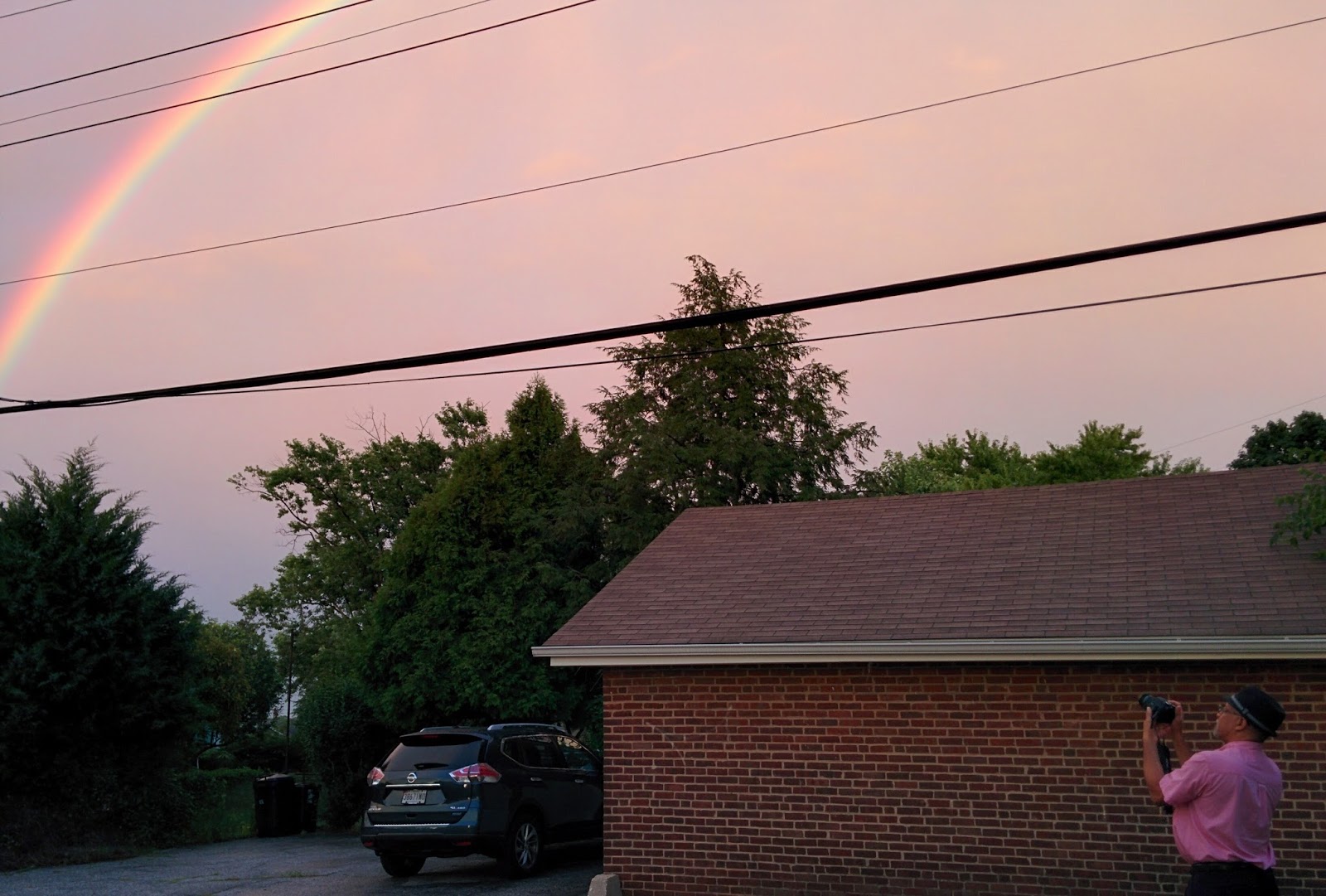
Capturing the rainbows that give applause to our belonging in the places we call home far from Home
When I'm awake to the wanderings of my soul as I was last night, I always find it playing and dancing and dreaming and resting its head on the hills of Taita, in Jangara. I may have a say in where my flesh and bones are laid to rest - and I say now that that place will be wherever it is that I breathe my last because soil is soil - but as for where my soul chooses to dance with the ancestors, I have no say in that matter. Earthly life is a dissonant belonging.
The full moon from outside mama's home shines upon the hills of Taita. In the US, they would be called mountains. They rise over 2000ft above sea level

Wednesday, December 20, 2017

The Passenger Who Squatted

Years ago, another lifetime it seems, I was preparing to drive to Machakos Technical Institute for the Blind when someone requested that I pass by that eternally chaotic country bus station called Machakos "airport" and kindly offer this stranger a ride.

We both had the same destination, Stranger and I. I said, Ok. I hadn't given any thought to how I would recognize a total stranger among a fluid crowd of countless beings who moved in and out and through each other, breathing each other's breath, disappearing in and out of buses belching black smoke ever so casually.

I had been to that "airport" without a car before, and I too never noticed the toxic fog that filled in one's lungs and nobody cared, nobody complained, nobody had any mind to fight because Right was an ideal too surreal, too removed from the chocking need for daily survival. Many in that fluid crowd woke up every day with a simple prayer- that they would race the day's sun and touch the edge of the coming night's frayed blanket and know they still had breath of life to race the next day.

I shifted the gears on my aunt’s Toyota DX and bullied my way through the bedlam of Nairobi city traffic and its maze of humanity like a pro, a thing I couldn’t do now, having gotten too used to a more orderly way of driving in another country where lanes matter, lights are obeyed, and metal gives way to mortals. 

I pulled over to a Machakos-bound bus and immediately saw my passenger. I knew it was him because he was the only one who had a blind cane. I came out of the car, we exchanged greetings, and I guided him to the back seat. I opened the door and asked him to get in. He felt the frame of the car door, felt the window, and felt the emptiness of the entrance. He paused, shot his sightless gaze upwards as if searching the heavens for something. 

I said to him- there's no one there, the seat is yours. He inched forward with trepidation. His cane was caught in the door frame and I folded it up for him. Then he felt the seat with his legs, lowered his head to fit into the frame, and squatted there with both his feet, complete with very dusty shoes, resting on the clean cushioning of the seat where his buttocks should have been. I was mortified! I quickly asked him to put his feet on the floor, silently hoping his shoes had not left a gunk of grime I would have to soap up and scrub clean. 

He sensed annoyance in my tone and mumbled something like an apology while touching his folded cane for familiar comfort. We were soon on our way, and with the soothing hum of the highway, the moment of mortification was forgotten, and we got talking. I learnt he was born without sight, and that he took the bus all the time to the Blind Institute. I could tell he was a poor man, which was inconsequential since so many in that city were poor. In a village of old people, creaking bones raise no eyebrows. 

Then it came to me. He had no idea how a saloon car is configured, never been in one. He had experienced a bus, and a bus allowed him to board upright and either stand or take a seat which was high enough from the floor of the bus, and all without the need to fold his cane. Having to enter a saloon car for the first time in his life, one he could not see, put him in a bind. The seat must have felt as if it was on the same level with the floor. After all, a Toyota DX is a pretty small car. I did a mea culpa, mea culpa, mea culpa. 

This memory comes visiting on a day I feel frustrated about our blindness to greater possibilities that we don’t see but deserve. Perhaps we fear to suffer shame for exposing our obvious poverty, we fear the loss of what is familiar when we decide to dare to demand another experience, one with greater comfort, one free from the pushing and shoving of a hustling humanity for whom being civil is a time-wasting luxury. Breaking the cycle of need and indignity demands we surrender the comforts of victimhood, feel our way around new ideas, and step into new spaces, even if we get it wrong the first, second or third time.

We got to the Institute, and my passenger was ever so grateful. I watched him happily greet his friends and disappear into a world whose acceptance was as warm as the light behind his eyes.

Artist Unknown
Sere

Wednesday, November 22, 2017

Ice Buckets and Pharisees: A Lesson in Gratitude

I have followed the work of Retina Foundation for years now, at one point accumulating binders of articles on potential cures that I printed off of online publications.
Until they got a Facebook presence which keeps followers very well updated. I never miss an update. With this latest one hitting my newsfeed, I feel particularly grateful to these unrelenting soldiers of research especially because the world knows little about their work.
They work to someday bring light to a darkened world, literally. Retinitis Pigmentosa (RP) is a rare genetic condition that progressively leads to total blindness. It has a very low profile because the % of those affected isn't that large.
I remember the Ice Bucket challenge that catapulted Lou Gehrig's disease into global limelight, providing much needed funds for research into a little-known disease. I wish every silent soldier in unknown battles had their ice bucket moment.
The latest gains made in RP are in gene therapy, a controversial area that also presents a lot of hope, reminding me that no cures come without controversy. An incident is recorded about the Pharisees plotting to kill Jesus for healing a man on a Sabbath.
Our present-day attempts to alleviate human suffering are equally rife with attacks from pharisaic authorities that benefit from the status quo. But we're grateful for those who dare to carry out "Sabbath healings" that involve confrontation with established powers.
We're grateful to those who choose to see the suffering of a minority as deserving of the greatest fight and inclusion into a world they're often locked out of.
We're grateful to those who refuse to say of a situation, "there is no cure", and instead march on through countless days, months, years... fueled by hope.
We're grateful to those who never see failure as a setback but as a block to build upon; and to those who keep funding struggles without counting the stumbles.
Happy Thanksgiving!
Retinitis Pigmentosa

Wednesday, November 15, 2017

The Child With Two Places

Many years ago, I recall a man coming to mama early one morning while the smokey mist still clung to the hills. He said, "Dada, I'm taking the child to the hospital." Mama said, "Oh, is the child ill?" The man paused and said, "The child has two places." I've always wondered how the doctors resolved that child's "two-places" gender. Our culture is mute about these truths.
This distant memory comes to me because I'm reading an article on healing communities, and then the author says, "As a queer, non-binary trans human with white privilege..." I pause. I don't understand half of it; I understand the meaning of the words separately, but put together to describe one's identity, my mind goes blank.
So I open a separate window and go into research mode, and I find a community of people who deal with bodily non-conformity that keeps expanding. LG.. LGBT... LGBTQIA..... with all its attendant tension. I'm in curious awe again, at what nature, environment, and its human co-creators are up to, and what they do to resolve issues of "two-places".
I live in a time and age when I can consciously observe life shifting and shaping in real time. I also now live within a culture that is more conducive to learning and embracing the myriad shifting-and-shaping and born-this-way of earth's lifeforms, with wonder and awe rather than fear, judgement and rejection. Only the other day, two male lions caught mating in Kenya became the nightmare of that country's moral police.
I long rejected that punitive psychotic deity with an evil streak who hates part of creation and means to burn it in furious fires and watch it squirm in eternal torture because "the bible says so." The God of my mind is an unshackled non-conforming creator who sometimes gives ordinary folk in a Kenyan village a perfectly beautiful child with "two places."
Humans are not alone in this wondrous dynamic creation. But because our interaction is more often with fellow humans, we are bound to miss the same shifting and shaping and born-this-way discoveries with other earthly lifeforms, unless you catch it on National Geographics where those tireless observers of nature feed us with awesome knowledge.
Body art by Yoruba artist, Laolu Sebanjo who calls his style "nxgafromysterics - the mystery of the African thought-pattern". ["Yoruba tradition follows a unique cosmology and asserts that every individual has a specific destiny and fate, placing importance of self-understanding, religious nourishment and spiritual growth"] 

Friday, October 27, 2017

Finding Anchor in the Echoes of Biafran Storms

At the beginning of the year, in the throes of the US presidential election's woundedness, I borrowed these words penned by Rev. Frank Dunn, my former priest. Now I find myself needing to find anchor again as we go through the woundedness of Kenya's recent elections that have come with so much anger oozing out of unhealed scars, loss of life and malignant hate.
These words so perfectly reflect the storm brewing over a young nation struggling to hold itself together, but daily surrendering to the savage seduction of propaganda, the spread of malice, the rejection of what is true, and using God to stamp every prejudice and loath for fellow humans.
[Brackets mine]: I commit-
"I commit myself to telling the truth, as much as I have the light to see the truth. This is the age of lies, and it is getting worse. We are reaping what we have sewn: debased journalism; an internet where any assertion passes as fact; a disdain for education; the mockery of independent thinking, a pandering to anti-intellectualism; the ossifying of political opinions and letting them pass for "truth;" an embrace of racism [ethnic bigotry], xenophobia [othernizing], patriarchal privilege [political privilege], and brute force as a means of addressing conflict.
"There is no issue in the entire thesaurus of human activity that is not at some level a spiritual issue. That is to say that behind all our problems, including the suppression of truth, is a refusal to accept our own complicity in living falsehoods, and our reluctance to become conscious of our connection with everything--every single thing--in the universe. Instead, we imagine ourselves to be superior to other species, to be the gods of creation, the "stewards" of nature with which we can do whatever we please. Within our own species we view ourselves as locked in a contest to see who can amass the most power to manage and manipulate others.
"I commit myself especially to challenge religious falsehood where I see it. That opens me up to the criticism of being arrogant, self-righteous, judgmental, and guilty of the same ills which I would point out in others. I know that. I accept that. And if I should prey upon a brother for the speck he has in his eye while ignoring the log I have in my own, I should and must be called out. I submit myself to that criticism. Moreover I commit myself to an honest self-examination and an openness to accept my limitations and my errors to the extent I am able to do so. I pledge myself to be and remain in communities where I can be held in mutual accountability for facing and telling my own truth."
- Words by Rev. Frank Gasque Dunn | Dec 2016. With gratitude.
"Storm Over Biafra", a painting by Ben Enwonwu. A reminder of the storm of secession brewing over Kenya


Monday, October 16, 2017

Holy Hate

From the corner of my memory’s eye I catch this movie in which a community decides to collectively hate on this Jewish guy who always wears a hat. The kids are fed a belief that the guy has horns under his hat…. what’s the name of that movie… so a generation of youngsters is growing up hating a Jew (and therefore all other Jews they’ll ever know) because they believe he has horns growing out of his skull as a sign of his inherently evil nature. He’s the boogieman they dare not come near… darn it, what’s the name of that movie… There's a funny scene where two of the kids who know the truth decide to lure other kids to the Jewish guy's home so they can see his horns when he takes off his hat. The knowing kids laugh themselves silly when the other gullible kids take off in terror upon seeing the man with the horns approaching... what the devil's horn's the name of-- forget it.
For now, "the man with the horns" is the real-life movie playing out in the Kenyan diaspora among a group that believes the man from the shores of Nam Lolwe is indeed Mephistophelian in nature. He’s Kenya’s guy with the hat that hides something diabolical, and he is to be greatly feared by the godly and spiritually favored group that has decided there's only one man annointed to lead the country. You have to attend a prayer rally like the one I attended last night (and stay to the end) to know what I’m talking about. The prayer meeting, dubbed "UhuRuto Tano Tena Diaspora Peace Rally" was at the beginning filled with fun, educational talk, good food, dancing and good-natured community love. I ate a lot of maandazi and chicken and chai and was happy to see friends.
Then came the sermon and prayers at the end, by which time half the people and the media had left. Too bad they missed such an important segment. But I'll tell you about it. The most terrifying thing was to watch a congregation that collectively believed in the demonic nature of this man, Raila, so strongly that they feverishly, on bended knees and prostrate spines, cried out to God to deliver Kenya from this man’s diabolic dealings in witchcraft which is affecting his followers and the entire country. I do not come to judge your faith or to question the veracity of such bizarre claims - heck, I don't know if the man is hiding a chicken claw that can run all by itself under his hat - but as a human being who refuses to stay silent in the face of crimes against humanity, I will point to the chilling markings of a dangerous collective mindset clothed in holiness and humility.
It is the kind of mindset that will silently watch the extermination of an entire community in the belief that the God of their faith is ridding the land of a great evil. It is the kind of mindset that will see the police bludgeoning to death of babies like Samantha Pendo, and the ruthless murder of people like Chris Msando and Carol Ngumbu, and the obvious targeting of a specific community, as part of a holy war. Somewhere in this madness that has affected diaspora Kenyans, there’s a light, and I know that light well because I have bathed often in its unpretentious generosity. At a time like this, we must dare invade each other’s exclusive spaces even when we're not welcome, talk to each other long enough, heart to heart, across the divide, however difficult the conversations, and only then will we begin to find each other’s shared humanity.

Friday, October 13, 2017

The Mad Man and the Wicked Ruler

It's fascinating how smart and passionate the ordinary Kenyan can get when it comes to debating the Constitution and election laws, yet surrenders the same smarts and passion when it comes to the things that oppress them the most. I'm talking about the hoi-polloi ordinary Kenyan, not the intellectual pundit who eats three meals a day.
Poverty is the foremost biting injustice suffered by thousands of same ordinary Kenyans, many rising and retiring daily in unspeakable squalor, thousands with that constant fear of where to get the next meal or how to pay rent or what if that sick child won't survive the night or what will happen if people find out that my church-going wife is the same night-time sex worker at Aden Joint who feeds our family through prostitution. And a lot of same said ordinary Kenyans in squalor are graduates too.
This level of poverty is a crime is a crime is a crime. There's a class of people in charge of the instruments of political and economic power who have cultivated it, enabled it for their own benefit, and they know it. There's a greed virus in their minds that tells them there isn't enough for everyone, and a stupidity virus that makes them sit contentedly on the fat fruit-filled branch of the tree while the people at the bottom angrily saw off the trunk of the same tree so they can get to the fruit.
The greed and stupidity viruses make this class of rulers do bizarre things like steal billions from public coffers, meanwhile the people with the mtu-wetu virus still vote them back in. This class of rulers signs bad contracts through corporate gluttony and the people celebrate them for bringing development which they could never afford to enjoy. This class of rulers swats off smart thinkers who are trying to empower ordinary folk because these thinkers are like flies buzzing around their meat.
Deep inside you know there's something very wrong with the whole setup. So what do you do? You decide you're too powerless to do anything about it and you choose to claim spiritual superiority. You dish out bible verses everyday just to convince yourself that your situation is somehow willed by God herself and She will reward you with a mansion in heaven. Your shallow self-serving preacherman tells you not to question those God has put in power, however oppressive they are. You conveniently choose to believe this manipulative lie because it supports your pathetic prejudices.
Allow yourself to be smart for your own good for once; not for someone else's gain. If you're languishing in poverty, having worked hard to no avail, sent hundreds of resumes as a graduate and never found a job, lost everything you had, fell off the cliff of experimental capitalism and split your head because there was no welfare cushioning to catch you, wake up to the realization that you're both the victim and willing participant in the ongoing game of profits at any cost that results in the kind of sick society you live in.
If you're religious like most Kenyans, for show or for real, then start looking for those bible verses that talk about truth and justice and ridding the land of wicked leadership. You don't need to worship those in power when they are not giving you the opportunity to thrive; heck you don't need to worship them at all. Stop preaching Levitical verses about not uncovering your inebriate father's nakedness when said father sits on immoral wealth while thousands languish in abject poverty.
Instead, embrace those who open your eyes. Practice the religion that empowers you. Say aloud, "Woe to the shepherds who destroy and scatter the sheep of my pasture!" / "When the righteous thrive, the people rejoice; when the wicked rule, the people groan". These are inconveniencing biblical truths that prick the comforts of your anemic tribal nationalism, but they are medicine.
You say- but the groans of the people are being caused by that mad man who wants power at any cost! You're getting mixed up over who the wicked ruler is "when the wicked rule, the people groan". The ruler is the person who has control of state machinery - military, legislative and economic instruments of power. The "mad man" who is zealously followed by many only has people power, which comes with the opportunity to shape history, but this person is not the ruler; he/she can be crucified in a minute.
"Lovely Greed 1st Timothy 6:10", a painting by Leighton Autrey

Thursday, September 28, 2017

Soiled Underwear, Ogres and Warriors: Kenyans' Difficult Relationship With Protest

Come my fellow Kenyans, let us sing a song. "Rosa sat / So Martin could walk / Martin walked / So Barack could run / Barack ran / He ran and he won so that all our children could fly." Thanks for singing along, and thanks Amy Dixon-Kolar for music in revolution. Keywords: Sat, Walk, Run, Fly.
Now, let's talk. Some of you are flying, and looking down at those walking. You're completely blind to why and how you gained the freedoms that enable you to fly freely. You're saying- look at those silly people taking to the streets to protest, only uneducated people, idlers and criminals do that, and when they get tear-gassed they complain oo ati serikali...
Then you also notice that some of those taking to the streets are people in the flying category. They have good jobs, some are well-titled personalities in successful professions, and you say- look at them perfectly sensible people, engaging in time-wasting activism, what an indignity, totally embarrassing...
It's the same mentality that drove some people who thought they were being sensible to say- If Raila has grievances he should go to court like a lawful citizen! As if protesting is unlawful, beneath the dignity of a person who's been a Prime Minister, like seeing your father marching down a Nairobi street with a placard shouting "We-Want-Justice!" You cringe at the thought. You forget people's fathers and mothers did just that so you could fly. In your mind, you have placed protest in the same category as the hanging of your mother's soiled underwear in public, ergo, only a mentally unstable person or an extremely narcissistic person would do such a thing.
None of your freedoms ever came without someone's struggle and great sacrifice. None. And taking it to the streets has always been a part of that struggle, a relentless pursuit of a goal that shifts the earth beneath the feet of the ogres of our times. Be glad elevated philosophies gave us the weapons of nonviolent revolution. Struggles remain a never-ending process of Sat-Walk-Run-Fly no matter how civilized our societies become. We just hope that we don't have to "keep protesting the same shit."
Whatever you choose to do to contribute to a better society, do not look down on those who choose to walk as if they were idle scum of the earth. The best of them are good at it, they have mastered the art of movement leadership, organization and mobilization, and they have the guts and brains to manoeuvre the process. They are warriors. It's as lawful as going to court, and the law should protect them.
Now, don't point at hooligans who callously steal and destroy during protests and tell me that is what nonviolent protest are. I can point you to thugs and killers in suits sitting in swiveling chair in the same skyscrapers you have your office. Would it be fair to say you're one of them?