Friday, August 10, 2018

Before 9/11 There Was 8/7

I was reminded that the 20th anniversary of the bomb attack in Kenya and Tanzania just went by. August 7th. Perhaps with very low-key commemoration. I saw an article in the Washington Post about Godec (US Ambassador to Kenya) saying the terrorists wanted to divide Kenya and US good relationship. Gobbledygook. That attack had nothing to do with Kenya.
It was a foreign war brought to African soil. Kenyans had no inkling on the rising tide of global terrorism. Local terrorism was a completely different animal — shiftas, cattle rustling and all. On August 7th 1998, Kenyans were going about minding their own business as they should, and suddenly, 213 of them and 11 in Tanzania were killed. A bomb blew up American embassies in both countries
Why was an American war being fought in countries thousands of miles away from America anyway? Easy answer to that can be found in history where powerful countries have the privilege of fighting their wars on other people’s soil.
It’s easier for a weaker enemy to target a superpower’s presence in less-secure countries, and many times, America itself has taken its wars to weaker countries. It’s like having dinner in your own home and going to shit in someone else’s bathroom because you don’t want the stink in your house.
All of Cold War between the US and then USSR was fought in Africa, Latin America and Asia. Citizens of countries like Mozambique who had no business taking up arms against each other in the name of Communism vs Capitalism went at it and slaughtered the daylights out of each other for years.
Ronald Reagan beefed up the war chests of mad butchers like Liberia's Samuel Doe to avoid a rise in communist opposition. Humble peace-loving Jimmy Carter fueled the brutal Somoza dynasty of Nicaragua. Five US presidents led a massacre of countless Vietnamese in a senseless anti-communism war. Meanwhile America thrived.
The Cold War was replaced by gwot (global war on terror), a well-orchestrated war machine that is still chugging along profitably. Unfortunately for the US, the gwot came with one of its most puzzling shockers- the use of American soil as a battleground on 9/11. Whether you take the conspiracy or no-conspiracy versions, that attack remains mindboggling and leaves American intelligence who dismissed obvious warnings with blood on their hands.
Remember by the time 9/11 came along Kenya and Tanzania had been tested as possible battlefields for gwot, an experiment that almost failed but later gained a measure of success very slowly, thanks to the ease of raising local proxy enemies through neighboring Somalia (enter Al Shabaab). Some devastating blows were dealt on innocent Kenyans, the worst being the slaughter of 148 University students in Garissa.
Kenya's current president gulped the kool aid on gwot like a champ. He waxed lyrical about our valiant troops in Somalia (who were either being used for racketeering in the charcoal and sugar trade or getting slaughtered). Kenya was outsmarted by Tanzania. The land of Mwalimu would have none of that send-our-troops to fight a proxy war they have no business fighting.
Meanwhile, America and all its power quickly diverted their 9/11 to Iraq and Afghanistan where hundreds of thousands of Middle-Easterners, and American troops (always the sacrificial pawns) died. Meanwhile astronomical profits were made by the US corporatocracy. Gosh, the money they've made.
Remember the famous words of General Smedley Butler: "War is a racket. It always has been. It is possibly the oldest, easily the most profitable, surely the most vicious. It is the only one international in scope. It is the only one in which the profits are reckoned in dollars and the losses in lives."
So, after being tested as a battleground for a new type of war profiteering and losing over 200 citizens, Kenya’s innocent victims are still fighting for compensation through US Congress. Just to remind you, the same Congress made compensation a priority for its citizens caught in the gwot attacks anywhere in the world.
Had the dead and maimed Kenyans been Americans, they would have been cushioned by very necessary, deserved and available financial compensation. Ask them about their lives now, how they’ve struggled to make ends meet, loss of jobs, limbs, eyes, minds.
For the rest of Kenyans, victims of any violence are often too quickly discarded into a gaping void of willful disremember. We tell them "kaa ngumu!" That's on us. America made sure the world never forgets 9/11. The world does not remember 8/7.

L: Art by Carlos Latuff | R: Artist Unknown

Sunday, July 22, 2018

Beliefs and Bullshit: The Enduring Sting of Vicious Gospels

Fattening and Sickening

“During the mission period, 3 out of 4 of the coastal Indians perished. They’d lived well free, but as soon as we introduced them to a Christian and community life, they fattened, sickened and died” – a Christian missionary during the Christianization of the Native American peoples, The West (Burns).

My mind goes to the parallels of devastation in my own country, Kenya. I have observed so much of similar fattening, sickening and dying among present-day Kenyans who have clung to a debilitating form of Christian thought decades after the colonial missionaries left.

Not all Christian thought is created equal. It’s like wheat from the fields that is meant to nourish. Some gets chemically altered, bleached and reduced in nutrients so that eventually it fattens, sickens and kills; and some is harvested and separated from the chaff just right so that its consumption strengthens and liberates.

A Cesspool of Heartless Spirituality

But the modern-day industries that monopolize and process Christian thought have little to no good intention. They are no different from the missionaries of old who conquered and killed in the name of God. A lot of modified, bleached and poisoned Christian thought is imported from the American evangelical industries to African countries, now mostly through social media, and consumed largely by the poor. 

I receive these emaciated over-shared cookie-cutter posts daily by Kenyan friends on social media who seem clueless about the moral bankruptcy, greed and political machinations of the American evangelicals they keep quoting. If these Kenyan believers are aware of this cesspool of spirituality they keep feeding from, then they've been indoctrinated to not judge the messenger because - they argue - "after all God uses sinners." 

It's drinking from that same cesspool of spirituality that got Kenyan evangelicals singing the praises of America's dirtiest electoral politics and its outcomes as if the brutish victor were the reincarnation of Christ himself. They were told it's all in God's Armageddon plan and you Africans need to toe the line lest Jesus finds you unprepared. A truly vicious gospel.   

This vicious gospel is heavily sold by small faith traders (miracle workers, guilt-peddlers, moral police, end-times preachers and prosperity gospellers) who thrive off of selling a gospel that leaves others in greater suffering. Like drugs that dock at the port of Mombasa, seep ghostlike into society where unassuming consumers get hooked, sicken their minds and die while the shadowy kingpins sit pretty on a mound of dirty wealth.

Prayerful and Peace-loving Citizen

So much of the depression in poor communities comes with a particular way of thinking and a spirituality that is itself the sting that carries the poison. A thinking that does not allow the believer to loudly claim power and personal responsibility to challenge what went wrong, what ails their society, and what should be done.

It’s a thinking that claws desperately at unseen spiritual forces that provide believers with the perfect excuses for not taking action towards healing and freeing their community from the ravages of calculated poverty and oppression. They leave it all to God. After all - they say - God willed them into these oppressive situations for his glory. And they have the bible to prove it. I would not wish such sickening spirituality upon the mind of a suffering enemy.

When some get tired of the boot on their necks and rise up in protest, you will find those infected with that debilitating strain of evangelization saying, “I’m not with those rebellious trouble-makers; I am a prayerful and peace-loving citizen and I’ll stay in my sanctified corner praying for calm to return for that is my portion.” As if there ever was calm in squalor and silent suffering.

Awakening

One would think that this sting afflicts only the uneducated hoi-polloi. Not so. Slum communities (or as some would prefer, economically depressed neighborhoods) in Africa are also home to hundreds of college-educated believers who feverishly share teachings from American evangelicals while their shacks burn in political turmoil and smolder in poverty.

One's awakening does not come without the dare to respond to that gnawing voice in one’s conscience. It bids you read books from competing philosophies that you’re forbidden to read and scour through critical blogs that challenge your mind’s comfort zones. Find a leading critical thinker to follow on social media and challenge them to duels of thought until you’re no longer terrified of your own mind’s ability to think for itself.

If these resources are unavailable, go into seclusion and think alone for 3 days, making sure to fast from sugary-sweet prayers of desperation. Just you and the power of your self-healing mind. If facing your raw thoughts by yourself scares you, find a friend who thinks very differently from you; one you can trust to take you through critical thought without judgement, and spend some quality time together. Do this even while your chained mind is kicking and screaming against leaving the comfort zones built from years of being told what to believe and how to think.

"Angel Eating Devil's Food" Artist: Tex Norman, Oklahoma City, OK

Sere

Tuesday, July 10, 2018

The Boy Who Brought Me A Touch Of God


The prayerboy:

Mohamed. Little boy back in Standard 4. All of 9 or ten years old. We were in the same class. Fast-talking little brat with a filthy mouth, loved to pick on quiet kids and called them names for fun. K***mako, macho kama gololi! Aaahahahaha! He would leave this one poor kid with big wonder-filled eyes blinking away tears.

Mohamed also had the voice of an angel, vocals powerful as ocean waves. We all knew that because he used to do the evening prayers at the township mosque. Sometimes I'd be sent to the market after school and every time I heard that piercing cry coming over the speakers-- Allaaaahu akbar... I'd stop and listen in a kind of trance.

It was pure, beautiful, spellbinding. I somehow knew there was divine essence in it when I had no cognitive understanding what the divine was.

The bully:

Mohamed and I walked the same path home from school. Only he stopped at Majengo where he lived and I went on towards the outskirts of the high school where we lived. I dreaded the times when we ended up walking that path at the same time.

One day he caught up with me and I crossed the road to get away from him and moved quickly ahead. He crossed the street, picked up a coconut shell from the ground and threw it directly at me. It hit me smack at the back of my head with bullseye precision. What I remember the most is how loud he laughed. I turned around and he crossed the street again and scurried off to find another kid to bully.

The assault lingered on like acid in my mind because I wasn't able to smack him back. Soon after, dad was transferred again and we left that town. Mohamed became the vague memory of a mean boy, but the memory of his voice remained hauntingly beautiful. It was the second time as a kid I'd experienced bullying.

First time:

The first time I was ever bullied, I'd had the opportunity to fight the kid. I used to be a non-talking kid and this firecracker of a girl kept prodding me with her wiry finger to see if I could produce a sound. She laughed gleefully every time I brushed off those poky tentacles.

One day I got fed up when her bully self came at me during recess and I fought her off. I saw my little hands and legs going at her like a furious propeller all by themselves. But she had shins like a set of spanners which gave her an unfair advantage. We became friends quickly, and I still never said a word to her.

As long as I made the choice to fight back, incidents of bullying or being treated unfairly held no power over me. It was that coconut shell finding its target that lingered on far too long. Or maybe it's because I could not reconcile Mohamed the mean bully and Mohamed the boy with the voice of an angel who entranced me with a touch of God at a very young age every time he recited the evening prayer.
A Muslim boy in prayer. Photographer unknown


Saturday, May 12, 2018

Beliefs and Bullshit: First Letter to the 43 Tribes:

1.Greetings to the sisters and brothers living in Kenya. I urge you to think on this: that you have no business giving to a church if it does not have one or all of these three basics: a mission to feed; a mission to clothe; a mission to shelter. 

2.Demand the running of soup kitchens because there are too many who go hungry everyday, even if you feed only ten per week. 3.Demand a collection point for hand-me-down clothing because there are too many ragged kids and families in the streets in need of some dignity. 4.Demand a system of identifying temporary shelters for too many getting kicked out of their homes for lack of rent and needing a hand up. 

5.Too many Kenyans churches, especially in the cities, are day-clubs with cliques for those looking for belonging and a place for desperate souls to numb their sorrows, and the pastor is the club owner getting richer everyday as long as he/she keeps them high and hooked. 6.You cannot call yourself a church if you're not IN the world serving those OF the world. Neither can you divorce your faith from social justice. 

7.Stop this "I'm just a passerby" theology that encourages apathy and makes you a silent supporter of those who steal and kill and use you for political gain. 8.Pretending to be not-of-this-world is making too many of you serial hit-and-run beggars who'd rather live through desperate indignity than confront the systems that use and abuse you. 

9.We're all of this world until we breathe our last. Our well-being is intertwined, rich or poor. And always remember, you're stronger than you think, no matter how deep in the valley you are. 

10.Greet all those in the family working so hard to make an army out of a valley of dry bones. Greet the youth who continue to take selfies and await an awakening to their collective power. Greet the mothers, whose love is pure, ever nourishing and deeper than the endless burrows of the anthills.

Sere


Friday, May 04, 2018

Beliefs and Bullshit: Things We Lost In The Flood of Salvation


The disappearance of intellectual wealth in African communities is directly linked to missionary work that killed professions such as storytelling, rainmaking and divination, all of which had seasoned experts, trade secrets and years’ worth of researched knowledge often dressed up in ritual for the consumer.

Secrets

Of course there were quacks and manipulators, and there was always incomplete research that was tested on consumers, a new herb that could either heal or kill. Life was its own lab. Rainmakers studied the relationship between the plants and the smell of the air, cloud formation, rhythm of the seasons. And when they came around like one of my grandfathers, Mghosi Tango who came from a long lineage of rainmakers, they carried with them a shekele  with which they consulted the gods. Believing in the spiritual realm did not mean their knowledge was not anchored in empirical study.

Grandpa Tango lost his mojo to a proselytization flood that ridiculed his trade, and also to the local brew that soothed the sorrows of those who found themselves without alternative expertise. Only a western education and salaried employment in a new Africa saved those who surrendered. Grandpa Tango had also been one of the keepers of the shrine at Msavulenyi, just up the hill from our home, and when he died, a lot of intellectual wealth was buried with him. Last I heard from my father, these keepers of the shrine were trying to revive their institution because it came with a lot of secret knowledge. What on earth did they know!

New rituals

The missionaries called all these bearers of ritualized intellectual wealth practitioners of ungodly trades, witches, and that included master storytellers. The salvation-bringers demanded the total annihilation of the African identity, if that was ever possible, and manipulated in their own rituals. Convert villagers partook of the holy sacrament -- the ritual drinking of a new deity's blood and the eating of his body. The priest would chant: the body and blood of Christ; the supplicants would respond: Amen, and eat a piece of bread with wine. The Catholic missionaries taught that the bread and wine literally became flesh and blood of the deity at the point of consumption.

Pentecostal missionaries taught converts to sing and shouted in gibberish not so different from the indigenous diviners' switch to strange tongues during intercession with the ancestors. Somehow these new rituals were supposed to be "holier", and the African ones "pagan". These missionaries really should have done what the Romans did while using Christianity to build empire. In the 4th century, the Romans incorporated the beliefs and practices of local people, like the feast of Saturnalia, which we all religiously celebrate as the birth of Christ. The failure to incorporate African traditions in to the new Christian faith resulted in generations of Africans with grotesque identity crises.

Cross Stitch artwork by Lisa Myers
Luke Skywalker and Nyange

Among the Wadawida (Taita), some of the best storytellers disappeared with the dawn of Christianity. Not everyone’s grandmother could tell stories around the fireside, and if they did, not all were master storytellers. Very few could create epic tales in the line of the Epic of Gilgamesh, The Mahabharata, The Iliad, and more recent ones like Star Wars. The epic journey of Luke Skywalker in Star Wars comes centuries after the equally entrancing epic journey of Nyange, a character from a tale among the Wadawida.

The complete Epic of Nyange is as long and complex in plot and thought as a Homeric poem, and finding someone who knows it in its entirety is like finding the rest of the Dead Sea Scrolls. My siblings and I had the privilege of knowing a master storyteller, grandma mѐ-Mwangi. She told us many incredible tales by the fireside in the homestead where my father and his siblings grew up. One was the Epic of Nyange. My sketchy recollection takes me to Nyange’s encounter with tricksters who tested his wit; malicious characters who broke his resolve; bullish encounters that drew him into physical fights, and yes, I remember the song he would sing:
Nyange mpuke,
Nyange mpuke,
Nyange kamakamaka,
Nyange puka mndu,
Nyange puka mndu.

Army of the Lord

So long was the tale of Nyange that I almost remember it taking hours. It took that rare breed of artistry to remember it, perform it with spellbinding mastery, and perhaps recreate intrigue with each telling, as was the nature of orature. A lot of grandma mѐ-Mwangi's works are lost through frayed memory. The only other places they were stored was a tape-recording I lost, and a Swahili translation of some of the tales that my big brother did, and that too was lost.

I never heard grandma mѐ-Mwangi say bwana ukaso (the Lord be praised), the common greeting among believers in Taita. Maybe she never got saved, which would explain her remarkable retention of all that intellectual wealth and her love for practicing it when she could. Saved griots shunned everything traditional. Not being saved in Taita, especially for an elderly person, makes one a rebel of sorts, a conscientious objector who will not serve in the army of the Lord! You can’t spit in any direction and not hit a believer in Taita. And maybe, just maybe, we will one day recover some of the precious things we lost in the flood. 

Wednesday, March 21, 2018

The Leaf That Fell On My Shoulder

One day I was coming home from school, all of ten-and-a-half little me. Then a lone leaf just came dancing its way down from a tree and landed on my shoulder. I did not think anything strange like- this leaf has been sent! But I do clearly remember thinking- A leaf! In a way I had never thought of any other leaf falling on my shoulder.
I also recalled having been told that if a leaf fell on your shoulders it means you'll receive a letter. I never gave it a second thought though. I was too young to give second thought to anything. My biggest think in my little world at that very moment was putting my school bag down and getting to play bladder and kati with the rest of the neighborhood kids till sunset. So I get home and my mother says to me- You received a letter! Blow me!
For a split second my child's mind exploded into a cosmos with ethereal possibilities, and just as quickly surrendered the awesomeness of that moment; a split-second moment filled with entertaining notions of life's fleeting surrealism that has words like superstition and dejavu coined out of it. Instead I took in the more tangible, graspable awesomeness of the moment - receiving the first letter ever in my little life.
I stared at it, wide-eyed. White envelope with blue and red stripes around the edges, my name on it, dad's office address and a real stamp on it. Written by someone, to me, mailed and delivered. Wow. If I could package that moment in my childhood, its worth could very well be in the same line with the wonder of Livingstone's first gaze upon Mosi-oa-Tunya - which he passed off as the "discovery of Victoria Falls", but that's a beef for tomorrow.
I opened it. It was from my big sister who'd gone off to boarding school that year. I don't even remember the content - maybe about how she must place her morning slice of bread on the desert plate and never on the big plate or a prefect will see her grievous crockery violations with the compound eyes at the back of their prefect-heads and book her -50; maybe about omnipresent Sr. Gemma who could see noisemakers in a classroom and late arrivals at assembly and sun-baskers in the yard all at the exact same time; maybe about the bell that rang at 5:30am for you wake up and screw your head on and it rang again at 9:30pm for you to screw your head off and put it to bed...
I don't recall the content, but I never forgot the receiving of that letter. And the lone leaf that foreran its arrival.
Mosi-oa-Tunya  -"the smoke that thunders" (Victoria Falls) on the Zambezi River
Sere

Wednesday, March 07, 2018

The Premolar Attack

Part I - Triage


Two nights before I met Dr. Fuller and Dr. Zhao, the pain had come knocking softly, like a shy relative in the village sent to greet the visiting city cousins. Just a soft harmless pulsation. I waved it off. In a few minutes, the knock grew relentless, rising in intensity until I could no longer ignore it. I popped some ibuprofen and waited for the pain to subside.

"Whiskey Sea", by Maria Fabrizio - When no amount of "whiskey" (whatever you do for pain relief) numbs you enough against the icebergs of life's unbearable pain. Such is the pain of a premolar attack!
I hate pain, but more than that, I hate making big pharma rich and will not swallow a single pill unless I’m convinced my life might be on the line. This time, it seemed quite clear a toothache was here to torture me to death. A tooth! Never underestimate the power of a pesky little enemy in the shadows who slowly drills into your inner circle.

It was well past midnight, and I had swallowed a whole mess of ibuprofens. I couldn’t take the pain anymore. I’m not a whiner I’ll tell you that. But this was pain straight from Dante’s ninth circle of Hell, and the devil had a red-hot prong of his pitchfork boring mercilessly right through my premolar, causing a fiery throbbing rhythm that sent my head in and out of waves of torment. I would never ever wish this intensity of pain on the devil himself.

My husband was lost and tortured by my groaning.

“Kill me! Kill me!” I mourned. “I can’t take it anymore!” Whimp!

“Let me hold your head, the pain will go away.”

 “It’s too much! Take me to the hospital…” Really!

“It’s going to be better by morning, I promise.”

“It’s taken too long and nothing is working. Just end my misery!” The stupid things we say over a toothache.

“That’s it. Let’s go.” He got out of bed. “We’re going to the emergency room now.”

Suddenly I wasn’t too sure any more about an emergency room run at 2 o’clock in the night.

“What do you think they will do?” I asked, trying to tone down my groaning. I felt like an annoying student about to be punished with time-out at the emergency room corner.

“They will stick a light up your tooth and give you some painkillers, refer you to a dentist and send you back home.”

“Ok, then, let’s not go. I’ll be quiet.”

“You already threatened me with your death, talking all that kill-me kill-me. We’re going!”

We drove through the quiet streets to a near-empty emergency room at the Good Samaritan hospital. They did my paperwork and we settled in to a long wait. So much for emergency. Above my head was the sign “triage” hanging from the ceiling. I was under a code red premolar terror attack and there was no triage doctor running towards me with the soundtrack rising to a crescendo like I see on TV medical dramas. I settled my throbbing head on my husband’s shoulder and tried to sleep.

As the morning broke, the doctor saw me, stuck a light up my premolar, prescribed me some oxycodone, and wrote me a referral to the University of Baltimore School of Dentistry. I'd been told this is exactly what would happen, hadn't I.

Part II – The Mystery


The University of Baltimore School of Dentistry has its prestige secure as the oldest in the world-- yes, in the world, I didn’t write that wrong. If the first modern dentist in the entire world graduated from this place right here in the 1840s, I was confident I was going to receive superior treatment.

They also have a first-come-first-served program that allows you to pay subsidized rates for very expensive procedures, and people travel from all over to make a beeline in the wee hours of the morning just to get in and have the students attend to you.

Teeth business is exceedingly costly in the US, even with insurance. As if these dentine body parts are any more important that fingers or toes. No wonder George Washington settled for wooden teeth-- ok, so they say there’s no proof of that, but there’s proof he had some sorry teeth. You ever seen an image of him smiling? No, he dared not.

My turn came and I met my assigned dentist students, Dr. Fuller and Dr. Zhao. They were extremely thorough, went far beyond the normal practicing dentist that I’ve been to. Perhaps it’s what you get from being treated by students whose work counted towards their graduation. No room for mistakes. I started enjoying their company. The teacher in me jumped out of the bushes of receding pain.

“What brought you two to such a smelly pursuit?” I asked them. They laughed, and both said they enjoyed being dentists. I asked them how long it took to graduate.

“Four years for general dentistry. Ten years for oral surgery,” said Dr. Zhao.

“Nooo!” I protested.

“Yup.”

“Why?”

“Oral surgery is an extensive field.”

“I don’t know what’s so extensive about cutting into gums and drilling into jaw bones,” I said with intentional naivety. Either way, ten years in school over teeth? Nuh-uh. Before going in for oral surgery, we had a lengthy conversation about teeth and cultures. They volunteered stories about their families, how Asian and Western cultures handled teeth issues. I told them Africans used twigs from certain trees for a toothbrush and I think they worked better than colgate. There I was, wakandaring up Africans.

As we talked, I started getting the feeling there was something that fascinated them about me but I wasn’t sure what. The questions kept coming, I kept “teaching”.

“So, do you have family?” one of them asked me.

“Yes. Plenty of it.”

Pause.

“Married?” Asked young Dr. Fuller.

“Yes. And my husband has had enough of this tooth drama.”

“Oh!” he said. I wasn’t sure what that reaction meant. It seemed as if he had just heard something quite unexpected.

“He rushed me to the emergency room over the pain and he had no sleep, poor guy!”

They look at each other, amused at something. There’s a private knowing, one I’m not a part of, and I’m now getting the feeling I’m the unknowing subject of their knowing. Like people gossiping about you in your presence, with you participating. I play along. It’s an interesting game.

“Kids?” Dr. Fuller went on.

“No.”

“Do you miss not having any?”

“Not at all. We don’t miss what we don’t have,” I said.

Then I noticed that he was holding my paperwork with all the details on me and he seemed to keep peering at it. It wasn’t until I was done with my oral surgery that the entire mystery became clear. 

At the lobby, Dr. Fuller had handed over my paperwork to the receptionist and said to her, “Please correct Ms. Hall’s gender right away.”

The dentist was angry with the receptionist for the careless mistake of ignoring the gender box and leaving it at the default “male”.

“Ok. I’ll print you a corrected form,” The receptionist said it without apology. For her, what she did with paperwork held no connection to medical decisions. Did she not know paperwork mistakes are a major cause of medical malpractice? Not that they would remove an ovary instead of a premolar. But this dentist was still a student, and he wanted no mistakes on his watch.

“Ms. Hall, I apologize for that mistake,” the dentist said. It was my turn to be amused. All along they thought I was male because the paperwork said so even if what they were seeing indicated I was female.

Part III – What Happened


Let’s back up to the part just before I went in for the oral surgery on my rogue premolar.

“What’s the prognosis?” I ask the dentists.

“Your tooth needs to go,” Dentist says.

“Can we not save it?”

“No. Sorry. The abscess is too deep.”

“But is there anything wrong with the tooth itself?”

“The tooth itself has no cavity but...”

“Then we must save it.” I insist.

I really wanted to save my tooth. That’s because my husband always says to me that his mother always said to him that whatever you do don’t ever let the dentist take a good tooth out of your mouth. So this is a battle that runs deep.

“Let me show you why we cannot save it.” The dentist is patient with me, and he proceeds to show me my x-rays and what they mean. “In fact,” he continues, “the lower premolar has to go too really soon.

I’m alert! I’m being robbed! Two premolars? What next? All my teeth? Are they fixing to set me up with dentures at my young and tender age? Am I their next guinea pig? After all this is a school. I proceed to put up a valiant fight. I'm keeping my tooth! I'm keeping my tooth!

“Ok then. I’ll go call the professor. She might give you a different opinion.”

I feel triumphant. I wait. Professor Schmidt was a grayed up senior dentist who wore a halo of experience around her elderly frame. She looked like she just popped out of an ancient dentistry journal. She proceeded to study my x-rays. I talked to her. I told her I’m keeping my tooth.

“I’m sorry, Ms. Hall, but here’s the reason it has to go...” I shut out her lengthy explanation, most of which I’ve already heard from the students. By this time I’m well-schooled in the human dental structure and all that it connects to. Nothing about the human body is simple, not a single thing. One could very well take ten years to study an eyelash and write volumes of books on it and still not know half the miracle of its existence.

My premolar had fought a good fight and it was time to part with it. I was taken in to the oral surgery room to have it taken care of.

                     --------------------

There’s an oral surgeon with gadgets in my mouth, and three students around her peering into my mouth. The surgeon is the teacher, I’m the blackboard, fully awake and numbed up where they are excavating my tooth. It’s all quite fascinating listening to her teach while I'm lying there. I close my eyes and let the conversation wash over me - the Premolar Cantata

“Take this and hold it down... ah... uh-oh... that’s ok... scrape deeper so it doesn’t cause her trouble later… Ok let’s start sewing it up...”

They are done in half an hour. Not a prick of pain. I almost want to start clapping for them. Until someone comes in with a piece of paper, a worried look all over her face. She was one of the students. What now? 

“Ms. Hall... I’m sorry but something happened during the surgery.”

What in dentist’s hell could have happened? I was wide awake. I heard it all. I was the blackboard for heaven’s sake, and I feel quite alright.

“I was working on your tooth and the scalpel slipped and cut through my glove and into my skin. Unfortunately it also had your blood on it. I’m requesting that you please sign off for an HIV test.” By this time she’s in sheer panic.

Pause. They all blink rapidly.

I laugh out loud. The look on her face! Was the terror in the room caused by the possibility of HIV infection from an African woman? Or was it the thought that I could choose to sue for careless medical procedure that I could argue also put me in danger? I laughed because in this moment of dread, I held the scalpel. Their lives could be determined by the decision I made.

“It’s ok if you don’t want to sign it but that will mean I have to take the test and wait for three months and be tested again...”

“That’s fine, I’ll get a test.” That broke the tension right away. The nurse drew my blood and told me I could wait a few minutes for the result. But I was starving and I had places to go and things to do and the sunshine outside waiting for me. I had no time to wait around.

“Please mail me the results,” I say. “But can I see what you took out of my mouth before I leave?”

“Sure, it’s right here.” The dentist lifted it between her thumb and index finger and leveled it with my eyes.

“There she is!” I said. “She’s a work of beauty that premolar, isn’t she. Lived in my mouth close to half a century. You served me well, you brave girl!”
Teeth Surreal - Dental anatomy art in ceramic by Heather Galler
                         ------------------- 

**Names have been changed to protect the privacy of individuals** 


Sere

Friday, March 02, 2018

Dissonant Belonging

Last night, the wind was howling in a north-eastern city in the United States. Storm's coming, said the weatherman. Started with raindrops drumming softly on roof tiles as I welcomed nightfall with a mind at rest. 

Looking outside the window at the swaying trees felt soothing, melodious, and the feeling fastened a pair of studs on the feet of my mind and galloped me far out across the oceans, way out into the land of my perpetual being, my absent belonging, the place where my mind tucks itself into a pocket of unbridled comfort and elicits a feeling of euphoria I can only explain as touching God. 

Home. A place called Jangara. Up the hills of Taita where serenity lives on the branches of the trees, drips from the leaves of banana plants, rises with the fog of the morning, whistles with the rushing of the wind as it escapes the scorching of the savanna to rest on the cool of the crest up the hills, sings with each raindrop as it drums up an ancient symphony on rooftops. 
Looking down at the banana plantation in Jangara
I said to my husband: Of all the places in the world I'd rather be if I had a chariot that could transport me in a blink, I'd rather be in Jangara. A thousand times over, I'd rather be up those hills where my soul lives and has never left. I told him I don't know how it is that my body is able to find a home anywhere, but my soul insists on living somewhere else.

I've traveled into a land oceans away, found belonging among strangers, drenched foreign soil with my sweat and toil, and thrived far away from the home where my soul dwells. 
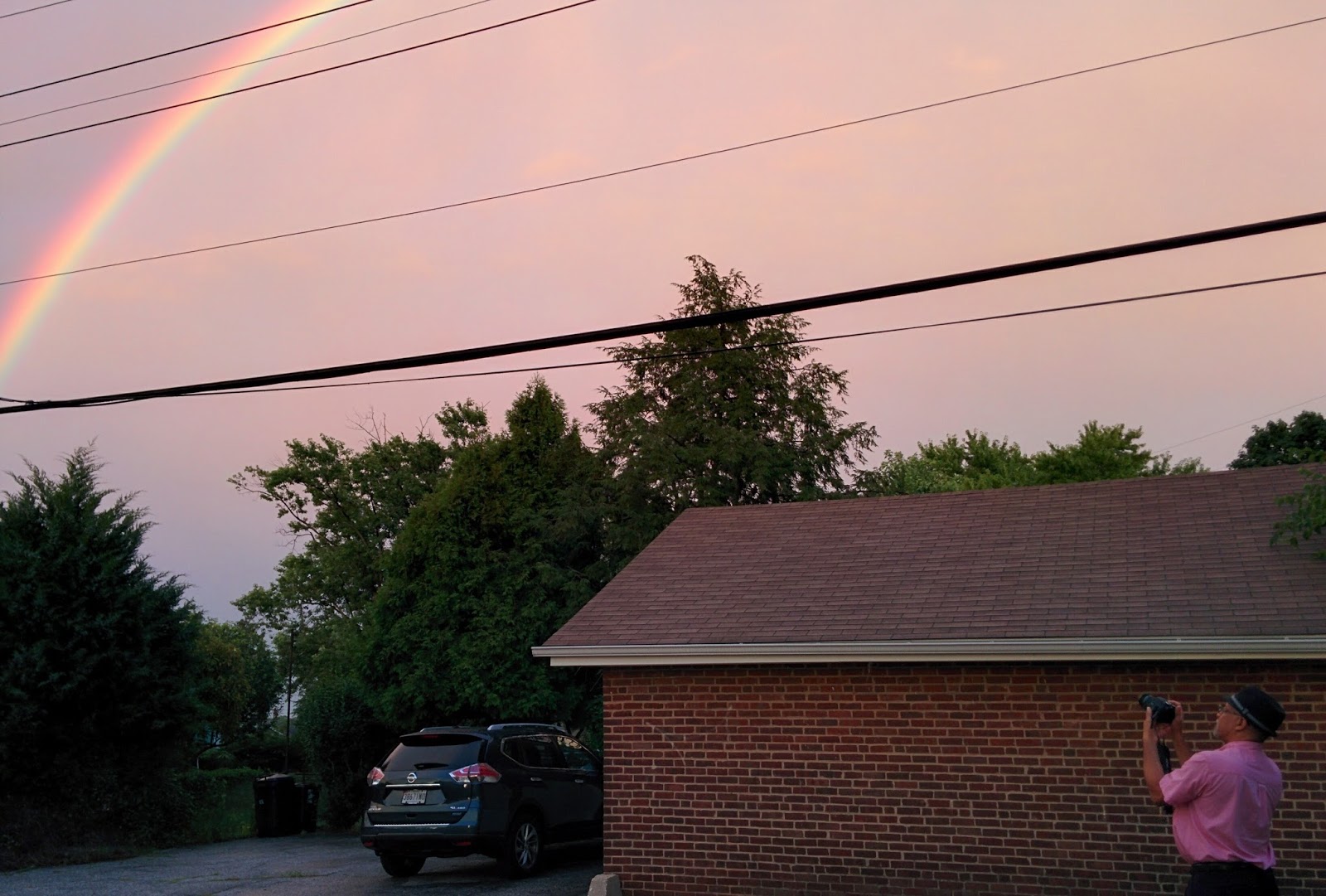
Capturing the rainbows that give applause to our belonging in the places we call home far from Home
When I'm awake to the wanderings of my soul as I was last night, I always find it playing and dancing and dreaming and resting its head on the hills of Taita, in Jangara. I may have a say in where my flesh and bones are laid to rest - and I say now that that place will be wherever it is that I breathe my last because soil is soil - but as for where my soul chooses to dance with the ancestors, I have no say in that matter. Earthly life is a dissonant belonging.
The full moon from outside mama's home shines upon the hills of Taita. In the US, they would be called mountains. They rise over 2000ft above sea level

Wednesday, December 20, 2017

The Passenger Who Squatted

Years ago, another lifetime it seems, I was preparing to drive to Machakos Technical Institute for the Blind when someone requested that I pass by that eternally chaotic country bus station called Machakos "airport" and kindly offer this stranger a ride.

We both had the same destination, Stranger and I. I said, Ok. I hadn't given any thought to how I would recognize a total stranger among a fluid crowd of countless beings who moved in and out and through each other, breathing each other's breath, disappearing in and out of buses belching black smoke ever so casually.

I had been to that "airport" without a car before, and I too never noticed the toxic fog that filled in one's lungs and nobody cared, nobody complained, nobody had any mind to fight because Right was an ideal too surreal, too removed from the chocking need for daily survival. Many in that fluid crowd woke up every day with a simple prayer- that they would race the day's sun and touch the edge of the coming night's frayed blanket and know they still had breath of life to race the next day.

I shifted the gears on my aunt’s Toyota DX and bullied my way through the bedlam of Nairobi city traffic and its maze of humanity like a pro, a thing I couldn’t do now, having gotten too used to a more orderly way of driving in another country where lanes matter, lights are obeyed, and metal gives way to mortals. 

I pulled over to a Machakos-bound bus and immediately saw my passenger. I knew it was him because he was the only one who had a blind cane. I came out of the car, we exchanged greetings, and I guided him to the back seat. I opened the door and asked him to get in. He felt the frame of the car door, felt the window, and felt the emptiness of the entrance. He paused, shot his sightless gaze upwards as if searching the heavens for something. 

I said to him- there's no one there, the seat is yours. He inched forward with trepidation. His cane was caught in the door frame and I folded it up for him. Then he felt the seat with his legs, lowered his head to fit into the frame, and squatted there with both his feet, complete with very dusty shoes, resting on the clean cushioning of the seat where his buttocks should have been. I was mortified! I quickly asked him to put his feet on the floor, silently hoping his shoes had not left a gunk of grime I would have to soap up and scrub clean. 

He sensed annoyance in my tone and mumbled something like an apology while touching his folded cane for familiar comfort. We were soon on our way, and with the soothing hum of the highway, the moment of mortification was forgotten, and we got talking. I learnt he was born without sight, and that he took the bus all the time to the Blind Institute. I could tell he was a poor man, which was inconsequential since so many in that city were poor. In a village of old people, creaking bones raise no eyebrows. 

Then it came to me. He had no idea how a saloon car is configured, never been in one. He had experienced a bus, and a bus allowed him to board upright and either stand or take a seat which was high enough from the floor of the bus, and all without the need to fold his cane. Having to enter a saloon car for the first time in his life, one he could not see, put him in a bind. The seat must have felt as if it was on the same level with the floor. After all, a Toyota DX is a pretty small car. I did a mea culpa, mea culpa, mea culpa. 

This memory comes visiting on a day I feel frustrated about our blindness to greater possibilities that we don’t see but deserve. Perhaps we fear to suffer shame for exposing our obvious poverty, we fear the loss of what is familiar when we decide to dare to demand another experience, one with greater comfort, one free from the pushing and shoving of a hustling humanity for whom being civil is a time-wasting luxury. Breaking the cycle of need and indignity demands we surrender the comforts of victimhood, feel our way around new ideas, and step into new spaces, even if we get it wrong the first, second or third time.

We got to the Institute, and my passenger was ever so grateful. I watched him happily greet his friends and disappear into a world whose acceptance was as warm as the light behind his eyes.

Artist Unknown
Sere